
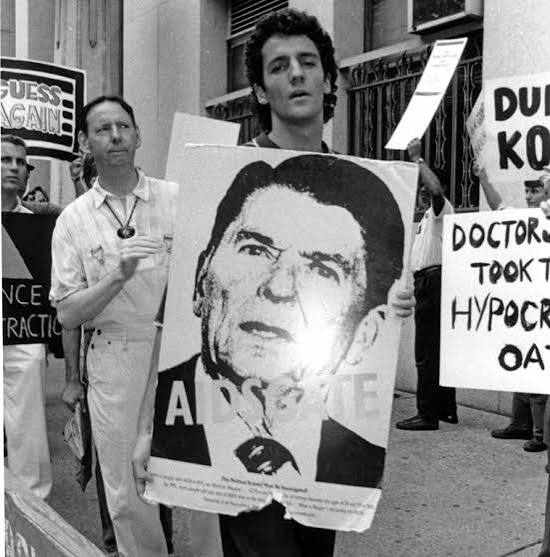
In the summer of 1981, the Centers for Disease Control and Prevention (CDC) published its first warning about a rare, aggressive pneumonia striking previously healthy young men. It was the opening chapter of the HIV/AIDS epidemic. Yet, as a mysterious killer began to tear through communities across the United States, the federal government remained profoundly quiet. At the center of this silence was President Ronald Reagan, whose administration’s protracted delay, ideological rigidity, and outright refusal to address the growing medical emergency severely crippled the early public health response. By the time the administration pivoted to face the crisis, an entire generation of Americans had already been pushed into the shadows of stigma, suffering, and death.

A Strategy of Absolute Silence
For the first four years of the epidemic, the most defining feature of the White House’s response was an eerie, calculated silence. Despite thousands of diagnoses and mounting casualties, President Reagan did not publicly utter the word “AIDS” until a press conference on September 17, 1985.
This public erasure was not an accident of oversight; it was a reflection of political calculation. The Reagan administration drew immense power from the “Moral Majority” and other religious conservative groups. Leaders within these movements openly framed the new disease as divine retribution against marginalized groups, particularly gay and bisexual men. By avoiding the topic entirely, the White House successfully signaled compliance with its political base, treating a fatal medical emergency as a taboo lifestyle issue rather than a national catastrophe–even as hysteria and misinformation about AIDS grew rampant in American society.

Ronald Reagan’s silence and policy delays during the early HIV/AIDS epidemic worsened the crisis, marked by his refusal to say “AIDS” publicly until September 1985, his press office mocking the disease, and critical funding requests being ignored or reduced.
Derision in the Press Room
While the President kept quiet, his press office actively minimized the human tragedy unfolding in major American cities. Archival audio and transcripts from White House press briefings between 1982 and 1984 reveal a stark pattern of mockery.

When journalist Lester Kinsolving repeatedly pressed White House Press Secretary Larry Speakes about the rising death toll and whether the President was tracking the disease, the room frequently erupted in laughter. Speakes routinely deflected the inquiries with homophobic barbs, asking Kinsolving if he had a “personal interest” in the illness and joking that he didn’t “own up” to knowing anything about it. This persistent locker-room humor, broadcast from the podium of the highest office in the country, effectively greenlit a culture of societal cruelty and institutional apathy toward dying citizens.
Starving the Science
Behind the scenes, the financial and logistical machinery of the federal government was actively withheld from the public health frontline. Throughout the early 1980s, researchers at the CDC and the National Institutes of Health (NIH) found themselves starved of the resources necessary to track, understand, and combat the virus.
Every year between 1981 and 1985, Congress actually had to step in to appropriate more money for AIDS research than the Reagan administration requested in its executive budgets. In some instances, the administration actively proposed deep cuts to public health agencies at the exact moment scientists were pleading for basic tools like microscopes, lab space, and field epidemiologists. Dr. Marcus Conant, an early pioneer in AIDS treatment, noted that the lack of federal funding forced doctors to rely on private donations to even print informational brochures about safe sex practices.
Activism Born from Abandonment
The devastating vacuum of federal leadership ultimately forced the targeted communities to save themselves. Denied government support, activists and medical professionals banded together to build their own parallel public health infrastructure.
In 1982, the Gay Men’s Health Crisis (GMHC) was formed in a New York City living room to provide hotlines, legal aid, and buddy systems for the dying. Years later, as the death toll surged past 20,000 without a major federal policy shifts, the AIDS Coalition to Unleash Power (ACT UP) was born. Utilizing radical, non-violent civil disobedience, ACT UP brought the reality of the dying straight to the doorsteps of Wall Street, the FDA, and the steps of the White House. They demanded immediate access to experimental drugs, an end to medical discrimination, and basic human dignity.

Too Little, Too Late
It was not until May 31, 1987—six years into the crisis and after more than 25,000 Americans had died—that President Reagan delivered his first comprehensive public speech dedicated to the epidemic. Speaking at the College of Physicians in Philadelphia, the President’s tone remained deeply divided. While he called for compassion, he heavily emphasized mandatory testing and moral abstinence over comprehensive sex education or civil rights protections for those infected.
Historians and epidemiologists widely agree that the administration’s initial four-year delay was a catastrophic failure of governance. Had the federal government deployed an aggressive, transparent public health campaign in 1981—focusing on safe sex education, clean needle exchanges, and heavily funded viral research—the trajectory of the global pandemic could have been radically altered, saving countless lives. Instead, the legacy of that era remains permanently tied to a costly silence.
The Cost of Silence
Stifled Funding and Resources: While grassroots organizations and scientists pleaded for federal mobilization, the administration proposed budget cuts to public health agencies and lagged for years in backing large-scale research initiatives.
A Grim Statistic: Nearly 50,000 Americans (specifically 46,134 officially reported cases) had died of AIDS by January 1989, when President Ronald Reagan left the White House.
Funding To Fight A Killer: The federal government spent a total of $5.727 billion on HIV/AIDS research, prevention, and treatment during the Ronald Reagan administration (Fiscal Years 1982–1989).
While annual spending grew significantly from a meager $8 million allocated in 1981 to over $2.3 billion by 1989, funding was a highly contentious issue. The Reagan administration faced heavy criticism for routinely requesting lower funding amounts than what the United States Congress ultimately chose to allocate.
Yearly Federal Funding Breakdown Of Reagan’s Two Terms In Office
The dramatic year-over-year escalation in total federal AIDS funding reflects the rapid progression of the epidemic:
- 1982: $8 million
- 1983: $44 million
- 1984: $103 million
- 1985: $190 million
- 1986: $504 million
- 1987: $923 million
- 1988: $1.605 billion
- 1989: $2.350 billion
A Legacy of Advocacy and Reckoning
- Activism Born from Neglect: The void of federal leadership galvanized groups like ACT UP and the Gay Men’s Health Crisis to demand basic medical research, care access, and human dignity for victims.
- Delayed Action: It was not until May 1987, when the death toll surpassed 20,000, that Reagan delivered his first major address on the epidemic at the College of Physicians in Philadelphia, famously calling for a mix of testing and traditional morality rather than a comprehensive civil rights response.
Where The Federal Government Stands In 2026
In 2026, the federal government fights HIV/AIDS through a bipartisan $5.88 billion domestic and international funding package, alongside executive actions to transition the programmatic footprint of the response.
The national approach relies on a structural division between Congress, which has consistently protected baseline funding, and the Trump administration, which is actively restructuring how global aid and domestic safety nets operate.
1. Domestic Healthcare and Prevention
Domestic efforts are driven by the multi-agency Ending the HIV Epidemic in the U.S. (EHE) initiative, which funnels resources into high-burden jurisdictions:
Ryan White HIV/AIDS Program: Receives $165 million specifically for EHE care delivery. The overarching program remains a vital safety net, ensuring medical care and antiviral medications for over half of all diagnosed Americans.
Community Health Centers: Allocated $157.25 million via the Health Resources and Services Administration (HRSA) to scale up rapid testing and PrEP (Pre-Exposure Prophylaxis) prescriptions.
CDC Prevention Strategy: Receives $220 million for high-impact localized prevention. However, the Centers for Disease Control and Prevention (CDC) is shifting its structure away from direct community-based organization (CBO) grants toward state-based umbrella grants, causing local outreach disruptions.
National Institutes of Health (NIH): Supported by a $400 million budget increase passed by Congress to maintain biomedical clinical trials and vaccine research
2. Global Health Initiatives and Restructuring

The U.S. remains the largest global donor to the HIV response, though its international operational footprints are changing:
- Bilateral Support (PEPFAR): Congress authorized $4.6 billion for the President’s Emergency Plan for AIDS Relief under the America First Global Health Strategy. Under new bilateral agreements, the U.S. is focusing funds strictly on frontline commodities and healthcare workers while integrating broad HIV operations directly into foreign country health systems.
- Multilateral Contributions: The federal government provides $1.25 billion to the Global Fund to Fight AIDS, Tuberculosis and Malaria, alongside $45 million directly to UNAIDS.
- Geopolitical and Budgetary Cuts: The executive branch has implemented sharp aid pullbacks. The Office of Management and Budget (OMB) has apportioned less than the full Congressional allowances, and the U.S. completely halted its historical $400 million annual PEPFAR funding to South Africa due to political shifts.
3. Policy Shifts and System Requirements
The federal framework for treating vulnerable populations is undergoing several systematic updates:
- Medicaid Reporting Requirements: Under the One Big Beautiful Bill Act, the administration introduced an interim rule requiring Medicaid recipients aged 19 to 64 to fulfill 80 monthly hours of work or qualifying activities. HIV advocates argue that the strict verification processes for “medical frailty” exemptions could disrupt coverage for patients relying on Medicaid for daily antiretroviral therapy. [1]
- State-Level Scaling: The federal government uses America’s HIV Epidemic Analysis Dashboard (AHEAD) to visually map and coordinate state-level containment plans across high-rate regions, particularly across the American South.
As of today, approximately 700,000 Americans have died from HIV/AIDS-related causes since the epidemic began, and more than 1.1 million people with diagnosed HIV are alive in the United States.
Check This Out...
-
Former Ward D Councilmember Stephanie Gordon Sponsors Tribute To Former Councilmember, State Representative Joe Heckstall: Bridge Dedicated To The Legacy Of East Point’s First Black Councilmember
-
Ugly Loss: Georgia Bulldogs Players Told To Put Helmets On As They Exited The Field Due To Alabama Fans Throwing Water Bottles, Cans At Team: Fan Appears To Shove Bulldogs Player’s Head: Georgia Fans React On Social Media As SEC Expected To Weigh In
-
Georgia Bulldogs Win In Regular Season At Alabama For First Time Since 2007, Now 6-0: Late Game No-Call On Assumed Penalty Stirs Controversy: Bulldogs Poised For #1 Ranking With Texas Loss
-
Minutes Away From Kickoff At 7:30 P.M.: The #2 Ranked Georgia Bulldogs Travel To Alabama To Face The 6th Ranked Crimson Tide: Both Teams Enter The Celebrated Matchup Undefeated
-
Atlanta Pride Updates Sunday Schedule, Cancels Saturday Events Due To Weather Circumstances: The Popular Parade And Multiple Other Events Will Take Place Tomorrow