

For over half a century, this city has proudly worn a title unmatched by any other American metropolis: THE “Black Mecca”. It was a Promised Land where Black political power, institutional wealth, and cultural dominance forged a blueprint for self-determinism. Yet, as Atlanta moves deeper into the late 2020s, that legendary crown is showing severe fractures. A bitter paradox now defines the city: While Black political leadership controls the highest levers of local government, the working-class Black residents who built the city’s cultural foundation are increasingly priced out of it.
The Architecture of a Legend
The origins of the Black Mecca were not accidental; they were meticulously engineered. Following the legislative victories of the Civil Rights Movement—which radiated globally from Atlanta’s own highly-esteemed Ebenezer Baptist Church—the city underwent a radical political transformation.
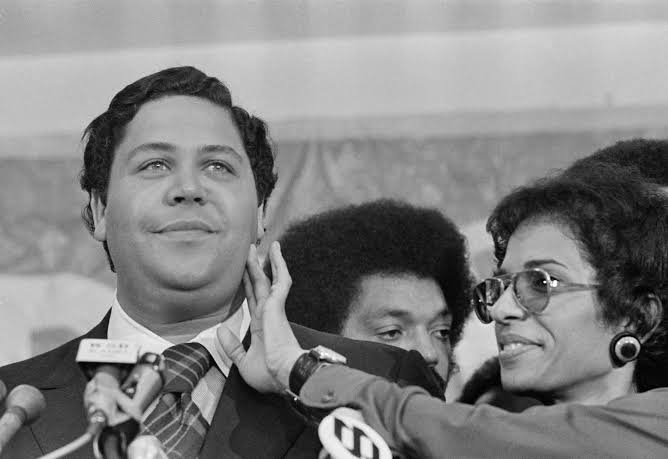
In 1973, Atlanta elected Maynard Jackson as its first Black mayor. Jackson fundamentally rewrote the rules of Southern governance. He pioneered aggressive affirmative action programs, mandating that Black-owned businesses receive a substantial share of city contracts. By the time he left office, Black participation in municipal contracts skyrocketed from less than 1% to roughly 40%.
This political shield allowed a vibrant Black middle and upper class to flourish. Anchored by the Atlanta University Center (AUC)—the historic powerhouse consortium of Spelman College, Morehouse College, and Clark Atlanta University—the city became a magnet for educated, ambitious Black Americans. By the time the 1996 Olympic Games arrived, City Hall and the White corporate elite had packaged a highly profitable brand: Atlanta was, “The city too busy to hate,” an oasis of racial progress and corporate prosperity.
The Math of Displacement: Too Expensive for its Own People?
Today, the most urgent question whispered in the barbershops of Southwest Atlanta, the cafes of the West End, and on the buses that take residents out of East Atlanta and closer to other areas of the city where jobs tend to be more plentiful for Black passengers is blunt: Is the city becoming too expensive for Black residents?
The raw economic data answers with a resounding yes for the working and lower-middle classes. The foundational promise of the Black Mecca was structural wealth creation, but a stark, modern economic divide has inverted that dream.
Recent local economic studies reveal a staggering, historic asset chasm: Within the city limits, the median wealth of White households is a massive $238,355, compared to just $5,180 for Black households. This 46-to-1 wealth gap is vastly worse than the national average, underpinned by a massive gulf in median incomes—historically hovering around $114,000 for White families versus just under $39,000 for Black families.
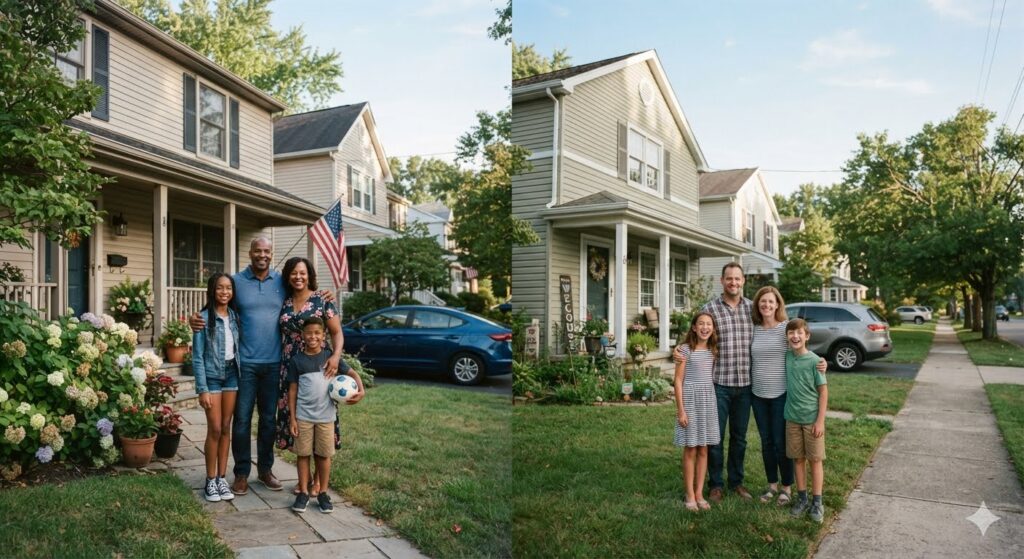
This wealth gap manifests directly in a brutal housing affordability crisis. While affluent Black transplants from expensive coastal metros like New York and Los Angeles continue to buy into Atlanta’s luxury markets, legacy “Grady Babies” (Atlanta natives) are being priced out entirely. Local real estate data shows that only 35% of Black city residents own their homes, compared to 58% of White residents.
Compounding the problem, corporate investors and private equity firms have aggressively bought up affordable single-family housing stock. The resulting rent hikes have triggered a profound housing instability crisis, with the metro area seeing more than 144,000 eviction filings in a single year—an epidemic that disproportionately displaces Black renters.
The Great Exodus: How Black Residents Left the Urban Core
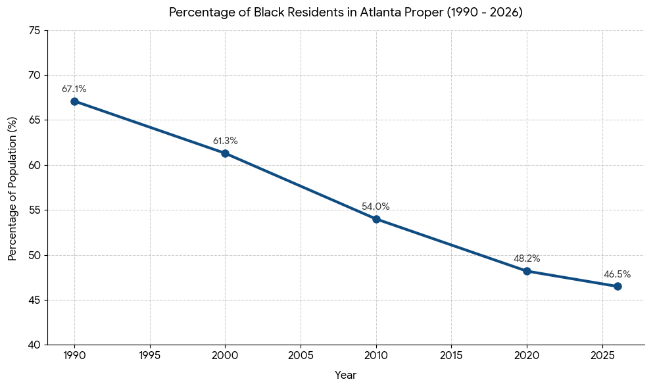
The demographic consequence of this economic squeeze is a historic, quiet migration. Black folks are leaving the city of Atlanta proper in historic numbers. For the first time since the Civil Rights era, the city’s urban core is seeing its Black population percentage decline sharply.
In 1990, Atlanta proper was two-thirds Black, peaking at nearly 67%. Today, rapid gentrification and hyper-inflated real estate have flipped whole neighborhoods: The city’s overall Black population has dipped below 47%. Historically Black strongholds like the Old Fourth Ward, Kirkwood, and Blandtown have undergone dramatic demographic inversions, shifting from working-class Black enclaves to majority-White luxury developments within a generation. It is a literal rewriting of the city’s map, pushing the people who gave Atlanta its Soul away from its center.
Ground Zero of Gentrification: Erasing the Brick and Mortar Foundations
When change came, it came unexpectedly–and fast.
To fully understand the housing squeeze forcing residents out today, historians point to a critical, aggressive shift in the city’s urban landscape that began three decades ago: The systematic demolition of its public housing.
Atlanta was famously the birthplace of federal public housing, opening Techwood Homes in 1936. However, in the lead-up to the 1996 Olympic Games, the city used the international spotlight to aggressively pioneer a new national trend: Tearing down traditional “projects” to make way for mixed-income developments.
The Olympic Clearance: Techwood Homes and Clark Howell Homes were promptly bulldozed in 1995 to clear space near Olympic venues, re-emerging as Centennial Place Apartments. This modern, mixed-income community offered drastically fewer deeply subsidized units, leaving hundreds of displaced Black families relying on Section 8 vouchers to find homes elsewhere.
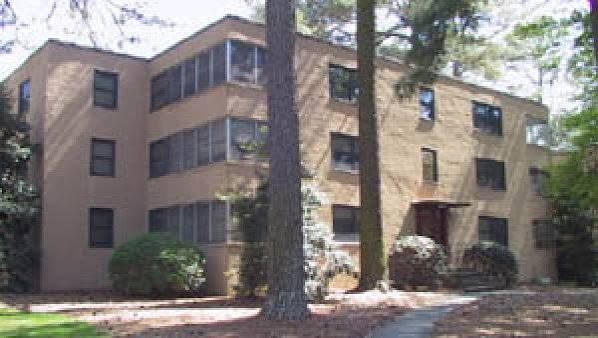
The Elimination of the Core: This strategy set off a domino effect spearheaded by the Atlanta Housing Authority. Historic complexes like Grady Homes and Capitol Homes were systematically leveled. By 2009, the demolition of Bowen Homes on the Westside marked the official elimination of the city’s final large-scale family public housing project.
While city officials praised the deconcentration of poverty, housing advocates point to this erasure as the structural match that lit Atlanta’s modern gentrification crisis. Traditional public properties were replaced with market-rate mixtures and Georgia Tech student housing—permanently reducing the inner-city footprint where working-class Black residents could afford to exist.
The Suburban Shift: Rebuilding the Mecca Beyond the Perimeter
As Black residents exit the urban center, they aren’t leaving Georgia entirely; instead, they are driving a massive “Suburban Shift.” The cultural weight of the Black Mecca has broken through the Interstate 285 perimeter, pooling heavily into outer metro counties.
The Clayton and Henry Boom: Southern suburbs like Clayton County and Henry County have absorbed tens of thousands of displaced urban families. Clayton County is now over 70% Black, creating its own independent hubs of middle-class Black political and economic power.
The Gwinnett Transformation: Once a conservative, majority-white suburban monolith, Gwinnett County has transformed into one of the most diverse counties in the Southeast, seeing a massive influx of Black homeowners seeking better-funded school systems and cheaper square footage.
The South Fulton Stronghold: The newly incorporated city of South Fulton has emerged as a suburban elite powerhouse, boasting a population that is over 90% Black, with high homeownership rates that stand in stark contrast to the city center’s dismal rental trap.
While these outer counties and the city of South Fulton offer cheaper housing and a chance at the American Dream, the suburban shift comes with a steep logistical penalty. Displaced residents face brutal multi-hour commutes into the urban core on transit-poor highways, separating them from the city’s centralized economic engine.
The Present: A “Housing Mayor’s” Radical Counter-Strategy
The city’s current chief executive, Mayor Andre Dickens, who himself was born and raised in the city’s historically-Black Adamsville neighborhood, finds himself fighting a war on two fronts: Preserving the city’s core Black identity while managing explosive corporate investment. Campaigning heavily on the mantle of the “Housing Mayor,” Dickens has acknowledged these threats of displacement, famously calling Atlanta a “group project.”
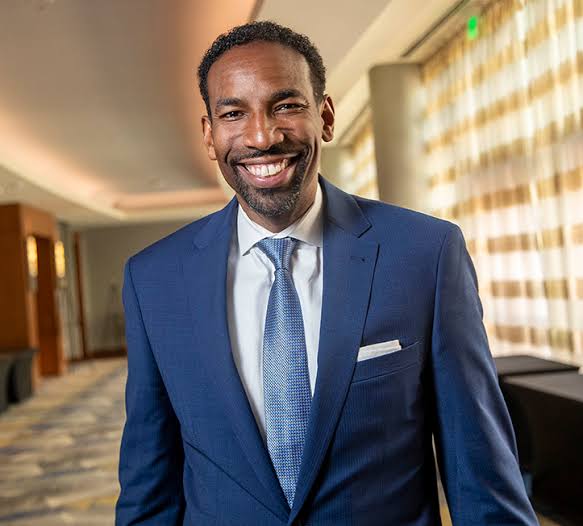
Rather than letting market forces completely dictate the city’s demographics, Dickens has launched a series of aggressive municipal interventions directly targeting Black displacement:
The 20,000-Unit Affordable Housing Mandate: Dickens set a legally binding goal to build or preserve 20,000 units of affordable housing by 2030. Backed by a $300 million Housing Opportunity Bond and private matching funds, the city’s Affordable Housing Tracker notes that over 11,000 units have already been completed or are currently under construction.
The Neighborhood Reinvestment Act: This comprehensive anti-displacement package redirects $5.5 billion into long-neglected neighborhoods across Atlanta’s south and west sides. The legislation uses Tax Allocation Districts (TADs) to fund affordable mixed-income housing, fresh-food grocery stores, and healthcare infrastructure.
Legacy Resident Retention: To shield multi-generational Black families from being taxed out of their homes by skyrocketing property values, Dickens expanded the Legacy Resident Retention Program, which provides direct financial assistance to pay off property tax surges.
The Housing Strike Force & BeltLine Mortgages: Dickens formed a centralized “Housing Strike Force” across ten distinct city agencies to cut through red tape and fast-track affordable construction. Simultaneously, his administration rolled out a $1.5 million BeltLine Mortgage Assistance Program, providing down-payment funds so that public servants—teachers, firefighters, and police officers—can buy homes near the city’s most heavily gentrified transit corridors.
…But The Squeeze Continues: A Race Against Time
Despite Dickens’ unprecedented deployment of municipal capital, housing advocates argue the administration is racing against an unstoppable tide. Rising global construction costs, severe labor shortages, and high borrowing interest rates have drastically changed development math. A project that cost $200,000 per unit to construct when Dickens took office now requires significantly more capital just to break even.
The city’s historic $300 million Housing Opportunity Bond, supplemented by philanthropic matching funds, was initially expected to easily carry the back half of the 20,000-unit goal. However, Atlanta Housing President and CEO Terri M. Lee recently acknowledged that the agency needs a massive infusion of new capital just to keep the remaining 9,000 promised units on schedule. As the gap between municipal funding and actual construction costs widens, the city risks building fewer units at higher costs, while private developers move twice as fast to erect luxury apartments nearby.
Simultaneously, the Atlanta BeltLine—initially envisioned as a unifying transit loop—continues to spark intense “green gentrification,” driving up property values and accelerating the very suburban exodus the city is trying to curb.

Federal efforts have tried to step in. The passage of the historic, bipartisan 21st Century ROAD to Housing Act—officially signed into law on July 11, 2026, and heavily negotiated by Georgia Senator Raphael Warnock—marks the most sweeping federal intervention into the U.S. housing market in a generation.
The law hits corporate landlords with a massive $1 million per-home penalty on any institutional investor who attempts to buy additional single-family homes once their national portfolio exceeds 350 properties. It also expands rental assistance by 100,000 units. Yet, housing advocates warn that because the law delegates zoning modernization back to local municipalities, it won’t bring quick financial relief to families facing immediate eviction.
Atlanta’s Black Mecca Status Being Challenged Outside The State?
As the cost of living turns the city proper into an exclusive enclave, competing Southern hubs are capitalizing on Atlanta’s hard to manage transformation. For decades, Atlanta was the unrivaled destination for Black Americans looking to build equity without coastal price tags. But as the city proper grows prohibitively expensive, emerging Southern hubs are aggressively positioning themselves as more stable alternatives for Black wealth creation.

Real estate analysis reveals that Charlotte offers a significantly lower barrier to entry for homebuyers, with median home prices sitting roughly 10% lower than Atlanta’s. Meanwhile, Houston completely undercuts Atlanta on housing flexibility. Due to its famously lax zoning laws, Houston’s explosive housing supply keeps its median home values lower. Crucially, Houston boasts a Black homeownership rate near 43%, significantly outperforming Atlanta’s city-wide rate.
Atlanta Remains Global Cultural Leader
But Atlanta’s global cultural output—from its multi-billion-dollar film industry and its undisputed status as the Capital of Hip-Hop to its unparalleled contributions to Black Civil Rights and Black political power, including it’s pivotal role in turning Georgia from a solidly red state to a bluish battleground state—remains safely intact.
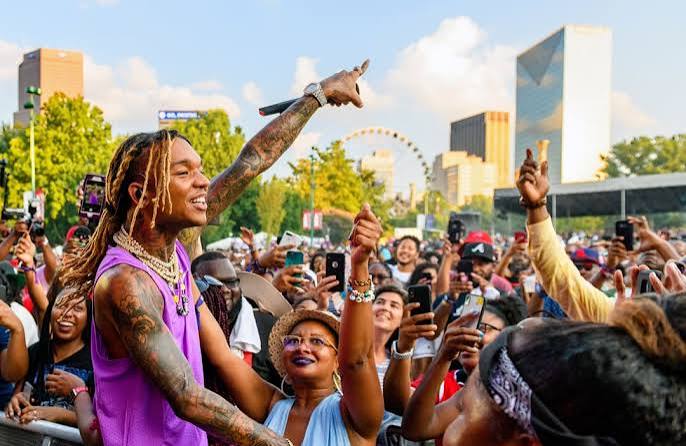
But culture alone does not make a Mecca. Without Dickens’ aggressive policies scaling up fast enough to bridge the staggering 46-to-1 wealth gap and withstand hyper-inflated construction realities, the historic capital of Black excellence risks becoming an exclusive playground for the wealthy—leaving its founding history behind in the suburbs.
And potentially paving an electrical path that makes ends Black political dominance in the city, perhaps even establishing Andre Dickens the last Black Mayor in Atlanta history.
Check This Out...
-
Collard Greens, Macaroni & Cheese, And Corn Bread: How This Meal Thrived Through The Slavery Era To Became A Southern Dinner Staple
-
Money Trouble: How Background Checks And The Criminal Justice System Negatively Impact Black Economic Power In America–But There Are Ways To Break Through
-
The Life And Death Of Donald Goines: Over 50 Years After His Murder, His Legacy In Street Literature Lives On–But So Does The Mystery Surrounding His Murder
-
Tying To Stay Friends After Breaking Up? Here’s How To Keep It Cool With Your Ex
-
‘Roots’ At 50: How The Groundbreaking Novel And TV Miniseries Forever Changed Ideas, Reignited Cultural Pride, And Sparked Discussions Around Black Enslavement