
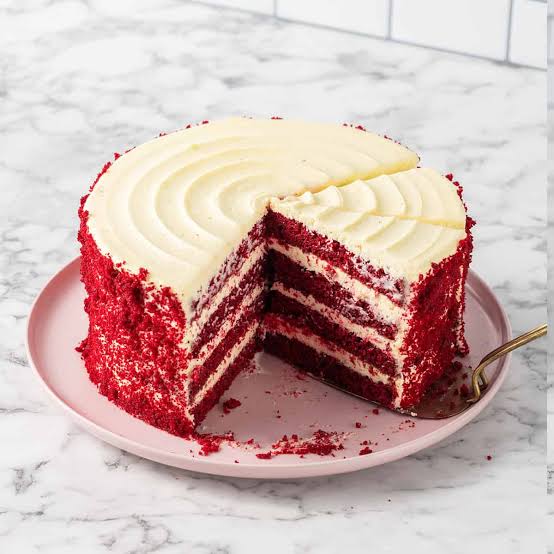
Move over Georgia Peach Pie. This cake is also a staple of Southern dessert lovers, and it can be found in virtually any bakery in metro Atlanta. And for many folks Down South, especially in Black families, the Red Velvet Cake is an indispensable holiday delicacy. So what’s the story of this delightful dessert, and how did it become so intertwined with Down South food culture?
The Victorian “Velvet” Accident
Long before the advent of artificial food dyes, 19th-century bakers sought ways to break down the coarse, heavy protein structures of standard flour to create a softer, more luxurious crumb.
The “Velvet” Crumb: Bakers discovered that adding acidic ingredients—most notably vinegar—tenderized the gluten in the flour. This resulted in an exceptionally smooth, uniform texture that earned these desserts the elite moniker of “velvet cakes”.

The Chemical Crimson: Toward the late 1800s, bakers began introducing raw, non-alkalized cocoa powder to these recipes. Natural cocoa contains anthocyanins, which are highly sensitive to pH levels. When this raw cocoa collided with acidic liquids like vinegar and buttermilk, it triggered a chemical reaction that tinted the cocoa fibers a faint, warm mahogany or brick-red hue.
Because it lacked the aggressive, fudgy density of a standard chocolate cake, this subtle, cocoa-kissed hybrid was frequently referred to as a “Mahogany Cake” or “Red Devil”.
High Society and the $200 Recipe
In the 1920s and 1930s, the cake migrated from domestic kitchens to upscale commercial venues, most famously the Waldorf-Astoria Hotel in New York City. Dubbed the “Waldorf-Astoria Cake,” the hotel served a version that relied heavily on this acid-cocoa reaction to stun wealthy patrons.
Urban legend claims a disgruntled diner requested the recipe from the Waldorf chef, only to be slapped with a $200 bill. In retaliation, she supposedly leaked the recipe to the public by printing it on cards and distributing them across city buses. While the accuracy of this myth is debated, it successfully propelled the concept of a luxurious “red velvet” dessert into mainstream American consciousness.
The Texas Dye Boom and Wartime Beets
The transformation of the cake from a subtle, muddy-brown mahogany to the shockingly vibrant crimson we recognize today was driven entirely by commercial interest.
The Adams Extract Gambit: In the late 1930s, John A. Adams—owner of the Texas-based Adams Extract Company—experienced the cake in New York. Sensing an opportunity to exponentially increase sales of his red food dye and synthetic butter flavorings, he began distributing point-of-sale recipe cards across supermarkets. These cards instructed bakers to dump generous amounts of red dye into a buttermilk-and-cocoa batter.
World War II Adaptations: As the 1940s brought strict wartime food rationing, commercial cocoa powder production processes altered. Industrial “Dutched” processing began neutralizing cocoa’s natural acidity, effectively killing the inherent red chemical reaction. To keep the tradition alive and stretch scarce sugar rations, resourceful home cooks began incorporating boiled beet juice or pureed sugar beets into the batter. The beets added moisture and naturally sustained the deep, ruby coloring.
Through the wild success of the Adams Extract marketing push, the dye-heavy recipe became deeply entrenched across the Great Plains and the American South, frequently appearing at church socials, bake-offs, and state fairs.
Though its roots are northern and commercial, the American South wholly adopted red velvet, weaving it deeply into the fabric of regional culinary traditions.
The Buttermilk Chemistry
Buttermilk was already an absolute baseline staple of Southern baking, prized for its ability to activate leavening agents in biscuits and cornbread. When the red velvet recipe drifted southward, Southern cooks immediately substituted standard milk with their plentiful buttermilk. The high acidity of Southern buttermilk doubled down on the tenderizing process, giving the regional version a melt-in-your-mouth plushness that cemented its status as a premium holiday dessert.
Symbolism, Juneteenth Traditions & Black Culinary Culture
Over the mid-to-late 20th century, red velvet cake gained deep cultural significance within African American communities, particularly during Juneteenth celebrations. Culinary historians trace the preference for red foods during these celebrations to West African heritages (such as the Yoruba and Kongo cultures), where the color red symbolizes spiritual power, resilience, and transformation. Alongside red soda, hibiscus teas, and barbecue, red velvet cake became a monumental symbol of freedom and celebration on the Southern table.
But long before vivid food dye was popularized, early “velvet cakes” achieved a subtle reddish-mahogany tint through chemical reactions between acidic buttermilk, vinegar, and raw cocoa powder. Formerly enslaved chef Rufus Estes included an early version of a smooth “velvet cake” in his landmark 1911 cookbook, Good Things to Eat.
After World War II, in 1948, legendary Ebony magazine food editor Freda DeKnight published a recipe for a cocoa cake utilizing red vegetable coloring in her seminal cookbook, A Date with a Dish. At the time, food dye was considered an aspirational, luxury ingredient. The inclusion of this recipe in a magazine tailored to stylish, middle-class Black Americans helped cement red velvet as a high-status showstopper for Sundays and holidays.
In the late 1990s and early 2000s, celebrated baker Cake Man Raven brought his perfected Southern red velvet recipe to Brooklyn, New York. His bakery turned the dessert into a massive cultural phenomenon across the Northeast, firmly anchoring red velvet cake as a quintessential element of Black American celebrations and Soul Food culture today.

The Cream Cheese Shift
The earliest iterations of red velvet cake utilized a tedious, French-style cooked flour roux frosting, often called ermine icing. In the 1960s, Southern bakers began pairing the cake with a dense, tangy cream cheese frosting. The sharp acidity of the cream cheese cut beautifully through the heavy sweetness of the dyed sponge, locking in the flavor profile that defining modern Southern bakeries.
The Steel Magnolias Resurgence
By the late 1970s, the cake experienced a severe national decline, dismissed by food critics like James Beard as “bland and uninteresting”. However, its identity as an eccentric Southern icon was permanently solidified in 1989 by the cinematic hit Steel Magnolias.
The film featured a red velvet groom’s cake sculpted into the shape of a giant, gray-iced armadillo. The visual contrast of slicing into a gray mammal to reveal a bleeding, blood-red interior captured the public’s imagination. The movie sparked a massive pop-culture revival, firmly re-establishing red velvet cake in the minds of the global public as an eccentric, beloved monument of Southern baking.
Check This Out...
-
Outkast And The Atlanta Falcons Team Up For New Merchandise Launch In Celebration Of Outkast’s 30th Anniversary Of The Supertar Duo’s Sophomore Album, “ATLiens”
-
Up To 55% Of Americans Turn To YouTube For Do-It-Yourself Home Repair Tips: Research
-
The Comforting History of Georgia’s Southern Fried Peach Pie: Not Talked About As Much Anymore, But Still A Treat + Recipe
-
Fall Is 3 Just Weeks Away: Tips To Get Your Home Ready For The Coming Season
-
Finding Love—And Even Friends With Benefits–On Social Media Is Growing More Popular, Giving Dating Apps Competition