
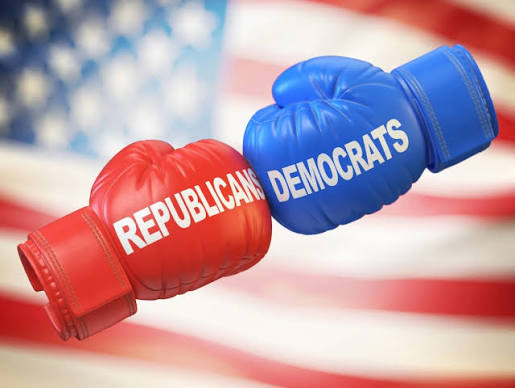
A stark paradox is defining the battle for control of Congress. Democrats have less money in their campaign chests, yet they have successfully forced Republicans onto the defensive in traditionally safe conservative territory, sparking an unprecedented late-stage spending blitz from the GOP.
From Texas to Nebraska, from Kansas to Maine, from Florida to Mississippi, and from Alaska to Georgia, state-level and federal Democratic candidates are running neck and neck and even ahead of Republicans in states that in some cases have not elected Democrats to major seats in decades.
Kansas, for example, has not sent a Democrat to the Senate since 1932. But the Democratic U.S. Senate candidate on the ballot this year is running even in polling with the incumbent Republican.
National polling averages and surging voter enthusiasm indicators suggest a shifting political landscape that has caught Republican strategists off guard, forcing them to try protect seats once considered safe.
Unable to rally voters behind an unpopular president and policies that many Americans believe have failed to deliver economic tangibles, Republicans are instead hoping deep pockets can keep them in power.
The Historic Cash Disparity
Entering the final stretch of the election cycle, Republicans hold a commanding financial advantage. Combined campaign committees and allied super PACs have amassed roughly $682 million for the GOP, compared to under $500 million for the Democrats.
The financial divide is most pronounced among the powerhouse outside groups driving television and digital advertising:
The Senate Battle: The Republican-aligned Senate Leadership Fund holds a dominant $239 million on hand, nearly doubling the $126 million held by the Democratic Senate Majority PAC.
The House Battle: In the fight for the lower chamber, the GOP’s Congressional Leadership Fund commands $142 million against the House Majority PAC’s $90 million.
In a bid to blunt Democratic momentum, Republican groups have launched a massive $700 million advertising blitz since September 1. This wave of late-summer and early-fall spending is being deployed not just to flip competitive districts, but to fortify Republican incumbents who suddenly find themselves vulnerable.
Enthusiasm Overcomes the Deficit
Despite being heavily outspent on the airwaves, Democrats are leaning into strong structural headwinds and indicators of heavy voter mobilization.
Democrats also have an unlikely ally in their quest to keep the GOP on political defense: President Donald Trump. The Republican chief executive has generated some of the lowest polling numbers in presidential history as the economy sputters and uncertainty persists in the Middle East.
Trump has also come under criticism for his spending of taxpayer money and questionable business dealings, all issues that is affecting voter sentiment.
Recent polling shows Trump at an average 43% polling level–the lowest for any American president during a midterm election in polling history.
A Testing Ground for Campaign Finance
The final weeks will test a fundamental political question: Can a historic flood of late-stage advertising reverse a wave of voter enthusiasm?
While the Republican financial advantage allows the party to sustain multi-front media campaigns, political analysts note that deep-seated voter anxiety over social policy, democratic institutions, and economic direction may prove resilient against standard negative ad barrages.
As early voting begins across multiple states, Democrats are banking on their ground game, voter dissatisfaction with Republican governance, and a polling edge to carry them through, while Republicans are betting their financial war chest to close the gap before November.
Americans don’t have much longer to wait to find out which party prevails: Election Day is four weeks away from today on November 3.
Check This Out...
-
More Than 520,000 Ballots Have Been Cast In Georgia Since Early In-Person Voting Began On Tuesday
-
20 Days Away: Democratic U.S. Senator Jon Ossoff, Republican Mike Collins Debate: Epstein Files, Tariffs, And Allegations Of Antisemitism Figure Prominently In Second And Final Debate Between The Two Candidates
-
Early In-Person Voting Begins Today October 13
-
Democratic Michigan Senate Candidate Dr. El-Sayed Addresses Past Obama Criticism, Jewish Safety In Meet The Press Interview
-
In November, Democrats Could Take A Majority Of Governorships For The First Time Since 2010