
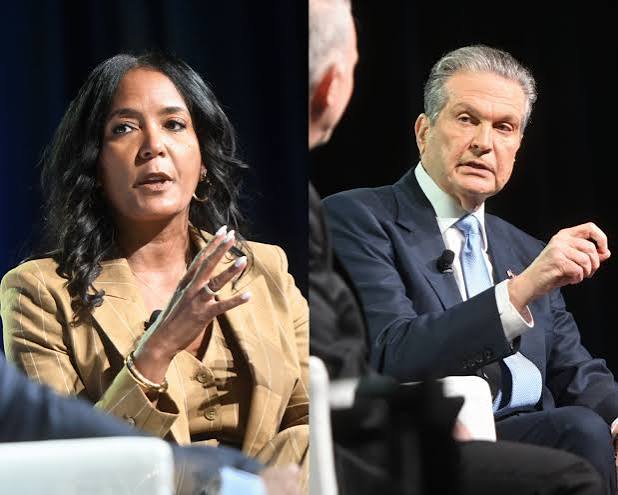
The high-stakes race to succeed term-limited Governor Brian Kemp enters its critical final stretch this week as Democratic nominee Keisha Lance Bottoms and Republican nominee Rick Jackson prepare for their first—and only—face-to-face debate on Tuesday, Oct. 6, 2026.
The televised town hall comes at a moment of maximum leverage for both campaigns. With recent public opinion tracking showing the candidates locked in a statistical tie, the unscripted broadcast is widely viewed as the most pivotal night of the state’s 2026 cycle.
A High-Stakes Shift from Airwave Warfare
For months, the battle for the governor’s mansion has played out almost exclusively through a series of aggressive, highly personal television attack ads–from both sides.
The Bottoms campaign has consistently targeted what it views as the origins of Jackson’s immense personal wealth, launching ads that tie his billionaire status to a “broken healthcare system.”
The Bottoms campaign has also attributed to Jackson the moniker of “Slick Rick” Jackson.
Bottoms’ messaging frames the owner of Jackson Healthcare as a corporate insider utilizing his fortune to fund misleading promotional campaigns.
In addition, Bottoms has also highlighted Jackson’s promise to be “Trump’s favorite governor” as the unpopular president’s polling numbers gradually shrank.
Jackson’s team has aggressively fired back by targeting Bottoms’ tenure as the mayor of Atlanta. The Republican has run ads accusing Bottoms of improperly using public funds, highlighting past controversies involving taxpayer-funded chauffeured car services and executive-class airline travel.
The Jackson campaign has also portrayed Lance-Bottoms as ineffective during protests over the George Floyd and Rayshard Brooks police killings.
Both campaigns have also run positive ads highlighting their candidates’ own background stories and connections to the community, with Lance-Bottoms featuring her mother, who opened a hair salon on the westside of Atlanta as a Black female entrepreneur.
Lance-Bottoms has also featured her family, which includes three sons and a daughter, all of whom are adopted.
Jackson has highlighted his journey from Midtown housing projects to billionaire businessman.
He has also featured foster children in his advertisements, along with testaments by the foster children saying Jackson helped them access educational support.
This will be the competitors’ first televised debate since both clinched their parties nominations. Back in September, Bottoms appeared alone on a Macon debate stage after Jackson declined multiple debate invitations, citing scheduling conflicts, making Tuesday’s event his sole confirmed appearance alongside his opponent.
Clashing Visions for Georgia
The debate, hosted by Atlanta News First, will be broadcast statewide across all Gray Media-owned Georgia television stations. Policy contrasts are expected to be highlighted across several central issues:
Healthcare: Bottoms, a former mayor and Biden White House official, has positioned statewide healthcare access and Medicaid expansion as core pillars of her platform. Jackson has defended his private-sector record, campaigning on a message of free-market solutions and economic freedom.
Infrastructure and Energy: Bottoms is pitching a temporary statewide “pause” on data center construction to study the environmental impacts and strain on residential utility bills. Jackson has strongly opposed state intervention, arguing that local municipalities should retain autonomy over data projects to help offset and lower local residential property taxes.
The Countdown to the Ballot Box
The debate will take place the day after the deadline for voter registration ends in Georgia on October 5. Early in-person voting begins on Tuesday, October 13.
With the polls deadlocked, the candidates’ first and only face-to-face debate could play a pivotal role in shaping the ultimate voting decisions of the small percentage of voters who have yet to make up their minds about who to cast their ballot for.
Check This Out...
-
More Than 520,000 Ballots Have Been Cast In Georgia Since Early In-Person Voting Began On Tuesday
-
20 Days Away: Democratic U.S. Senator Jon Ossoff, Republican Mike Collins Debate: Epstein Files, Tariffs, And Allegations Of Antisemitism Figure Prominently In Second And Final Debate Between The Two Candidates
-
Early In-Person Voting Begins Today October 13
-
Democratic Michigan Senate Candidate Dr. El-Sayed Addresses Past Obama Criticism, Jewish Safety In Meet The Press Interview
-
In November, Democrats Could Take A Majority Of Governorships For The First Time Since 2010