
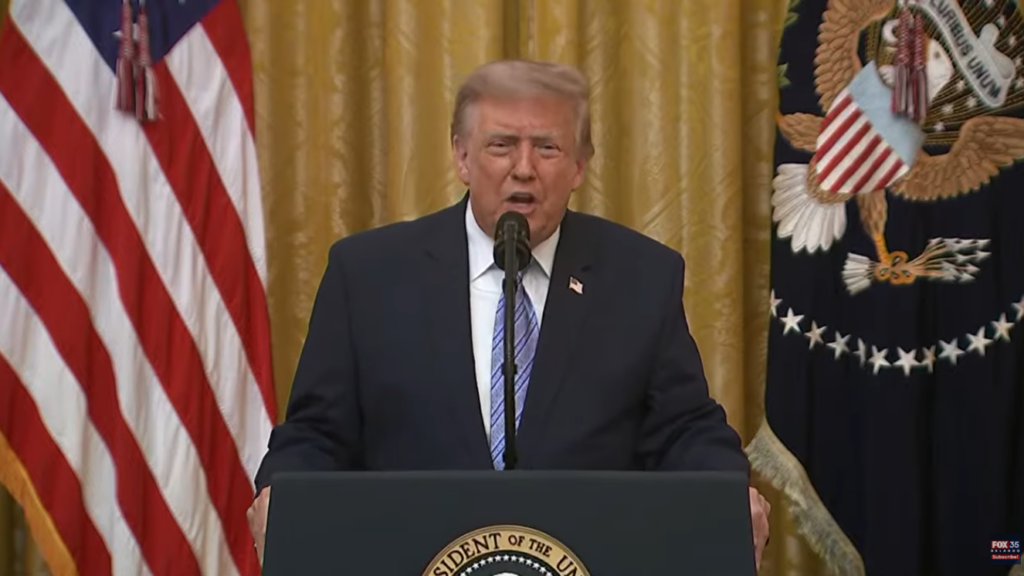
President Donald Trump delivered a highly anticipated primetime address from the East Room of the White House, utilizing newly declassified intelligence documents to attack U.S. election infrastructure and claim significant foreign interference.
Rather than focusing entirely on his administration’s current economic achievements or the intensifying military conflict with Iran, the president pivoted heavily to long-standing grievances regarding the 2020 election and warned of massive systemic vulnerabilities ahead of the upcoming November midterm elections.
The speech was met with immediate criticism from Democrats and caused notable anxiety among some congressional Republicans who would prefer the administration focus on kitchen-table economic issues.
Key Highlights of the Address
Declassification of Intelligence: Trump announced the release of hundreds of pages of heavily redacted, newly declassified intelligence files that he asserted expose “shocking vulnerabilities” in American voting infrastructure.
Allegations Against China and Venezuela: The president claimed that Chinese operatives had “bought, stolen, or hacked” 220 million voter files across 18 states and attempted to manufacture illegal ballots. He also pointed to CIA intelligence alleging a 2020 Venezuelan plot to digitally manipulate voting machines.
Voter Roll Accusations: Citing a Department of Homeland Security review, Trump alleged that over 250,000 noncitizens are actively registered to vote across California, Nevada, New Jersey, and Pennsylvania.
Media and Institutional Backlash: Trump fiercely attacked major media networks—specifically ABC, NBC, and CNN—for refusing to carry his speech live on broadcast television, accusing them of participating in a “plot” to hide institutional corruption.
Opening Summary of Successes: Trump opened his 25-minute address by praising his administration’s second-term record, citing a cooling inflation report, a strict southern border crackdown, and lower prescription drug costs via initiatives like his TrumpRx platform.
Fact-Checking and Criticisms
Despite the high-stakes presentation style, election experts, intelligence analysts, and state officials quickly pushed back on the president’s core claims:
Unsupported Claims: Reviews of the White House’s uploaded documents showed they did not directly substantiate Trump’s sweeping claims or show that foreign actors successfully altered vote counts. An official intelligence assessment also previously noted that while China considered influence operations, they did not deploy efforts to change election results.
State Refutations: Election officials from targeted states immediately disputed the administration’s numbers. A spokesperson for the Nevada Secretary of State’s office flatly rejected the data, calling Trump’s noncitizen voter estimates “wildly speculative” and unbacked by shared evidence.
Political Diversion: Congressional Democrats, led by Senate Minority Leader Chuck Schumer, slammed the address as a “pathetic” attempt to sow doubt ahead of the midterms and divert public attention away from complex, ongoing issues like the collapse of the Iran ceasefire.
What Are Trump’s Next Steps?
Following this primetime pivot, the administration is expected to take several aggressive legislative and executive actions.
1. Ramping Up Pressure for the SAVE America Act
Trump closed his address with a direct plea to Capitol Hill to pass the SAVE America Act. This highly controversial bill purports to protect election integrity by mandating strict photo ID at the polls and requiring documentary proof of citizenship to register to vote. Hardline Republicans have immediately renewed their legislative push, with proponents noting the bill must pass by early August to be implemented for the November midterms. However, the bill faces steep mathematical odds in a divided Congress.
2. Directing Federal Investigations
Trump confirmed he has formally requested the FBI, CIA, DOJ, and the Office of the Director of National Intelligence to launch sweeping investigations into what he calls a systemic “cover-up” of foreign election interference by past U.S. officials. He publicly ordered the FBI to reopen past cases related to data breaches and illicit voter roll acquisition.
3. State-Level Interventions and “Death by a Thousand Cuts”
Because federal election legislation faces a gridlocked Congress, the administration is actively pursuing a decentralized strategy. Observers note Trump is quietly restructuring the country’s election apparatus by defunding or reducing the footprint of agencies like the Election Assistance Commission (EAC). The administration plans to circumvent federal gridlock by coordinating directly with allied state-level officials and local clerks to purge voter rolls and enforce local technological restrictions on voting machines.
4. International Posturing: China and Iran
Trump’s heavy rhetorical focus on China will likely complicate upcoming foreign policy milestones. The president is scheduled to hold a massive bilateral summit with Chinese Leader Xi Jinping in the U.S., forcing the administration to balance harsh election-interference accusations with delicate trade and diplomatic relations. Concurrently, the administration must navigate a fresh wave of U.S. Central Command airstrikes in Iran following a breakdown in the regional ceasefire, meaning national security and global energy markets will remain top priorities alongside his election integrity campaign.
Check This Out...
-
Former President Barack Obama Electrifies Packed Ohio Venue In Support Of The State’s Senate, Gubernatorial Candidates: Obama Says “Basic Decency” Now Missing From The Nation’s Politics, Reminds Voters He Kept Nukes From Iran Without War
-
10 Days Until Election Day: Michigan Voters Could Vote To Restrict Utility Industry Cash In The State’s Elections With Approval Of Prop 2
-
More Than Half The Country Believes Trump Has Committed Impeachable Offenses, Including a Quarter Of Republicans: Poll
-
Longtime 82 Year Old Virginia State Senator Indicted: L. Louise Lucas Faces Federal Charges Accusing Her Of Trafficking Marijuana And Money Laundering: Lucas Vows To Fight Charges: “I’m Not New To This. I’m True To This”
-
13 Days Until Election Day: With Polls Showing Tight Races, Could Georgia Democrats Pull Off A Slatewide Sweep?