

A flyer is being distributed around the city that raises questions about expenditures made by Ward B Councilmember Shean Atkins via his city-issued credit card.
According to the flyer, Atkins has taken a “Valentine’s Day Trip For Two”, used city funds to pay for lunch with a developer and the city manager, and made two donations to a local historic church for $100 each.
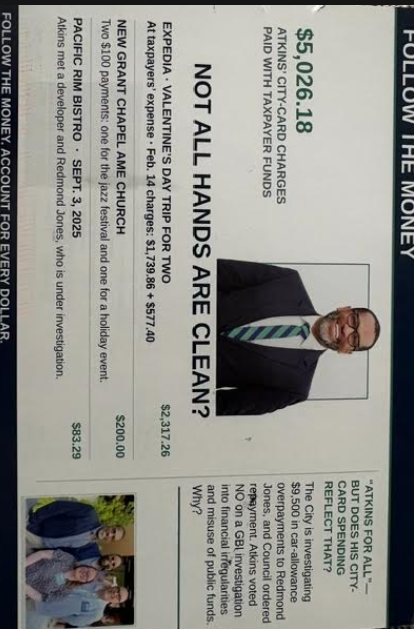
The East Point News obtained and reviewed Open Records through the City Of East Point for all 8 councilmembers, the mayor, and the currently suspended city manager.
Our research indicated Councilmember Atkins’ spending file easily eclipsed the individual spending files of the other elected officials in East Point and the city manager.
Atkins is serving his second year on council.
Lunch At A Buckhead Bistro With The City Manager And A Development Consultant
According to Atkins’ expense reports, he along with City Manager Redmond Jones–who was placed on administrative leave by the city council last month–in addition to a third individual described as a “development consultant”, had an afternoon lunch at the Pacific Rim Bistro, a Buckhead eatery, where the bill rang up to $83.29, including a $12.50 tip–paid for by East Point taxpayers.
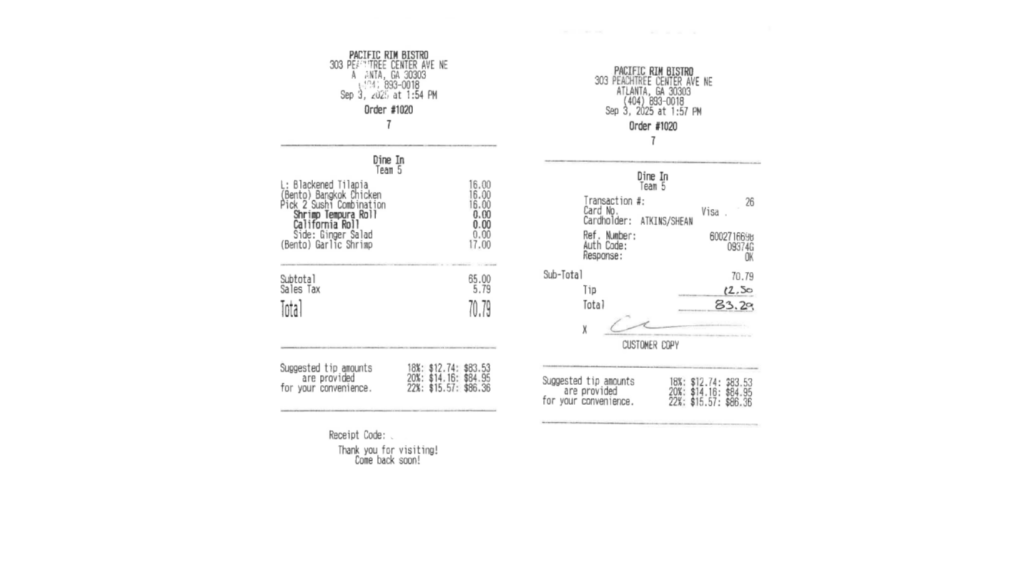
There was also a charge of $14.49 for parking; taxpayers picked up the tab for that as well.
What Georgia Law Says–And Why This Expenditure Is Concerning
While we cannot verify who did or did not eat among the trio, in Georgia, elected officials are strictly prohibited from using public funds to pay for meals for private individuals–including developers and consultants.
Georgia’s Gratuties Clause reads in Article III, Section VI, Paragraph VI(a) of the Georgia Constitution:
(a) Except as otherwise provided in the Constitution, (1) the General Assembly shall not have the power to grant any donation or gratuity or to forgive any debt or obligation owing to the public, and (2) the General Assembly shall not grant or authorize extra compensation to any public officer, agent, or contractor after the service has been rendered or the contract entered into.
This entry covers all levels of state, city, and county government, as well as other public authorities such as coroners and tax commissioners.
Because the law states that the government cannot grant any donation or gratuity, the exact definition of a violation has been shaped by legal precedent rather than a specific “lunch statute.”
The courts also dictate that meals are a “thing of value”, such as a gift. Under official ethics guidelines, a meal is legally classified as a gratuity if given without equal return value.
A development consultant is legally bound by their contract with the city. If an elected official uses public funds to buy them lunch on top of that contract, the government is giving away a “donation” without receiving any new, tangible benefit in return–which is not allowed.
Importantly, the city manager is a salaried employee with his own contract. Therefore, one elected official cannot use public funds to subsidize another employee’s daily meals.
Two-$100 Local Church Donations
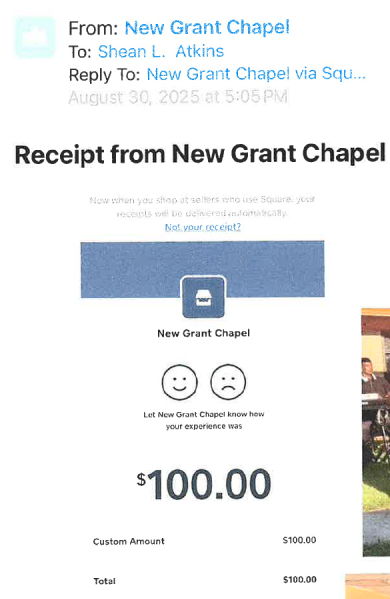
On two occasions over a span of several months in 2025, Councilmember Atkins used his city credit card to process two different transactions to a storied East Point church, New Grant A.M.E. Chapel. The first was on August 30; the second was on November 26. On both dates, the city’s credit card was charged $100 each.
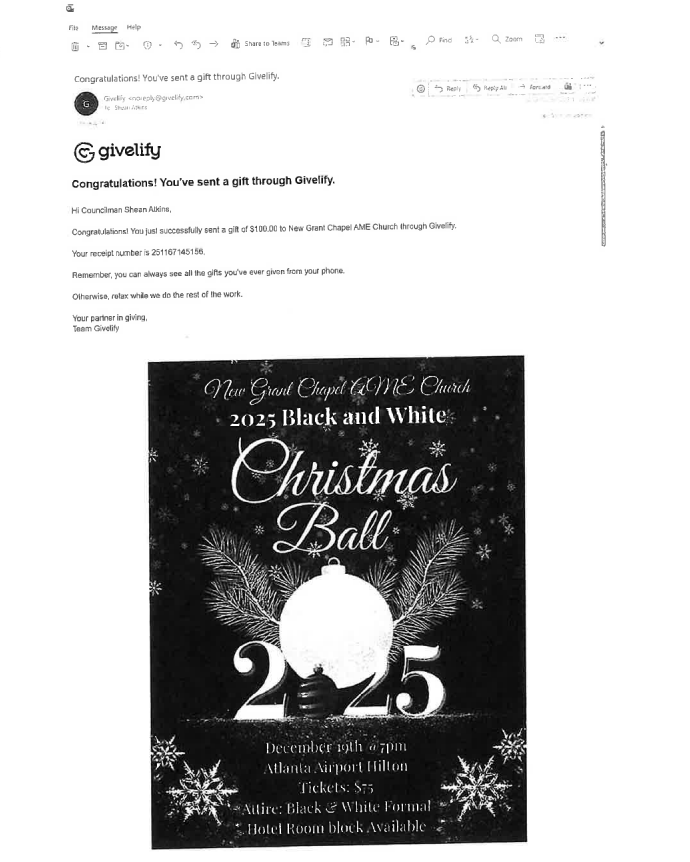
The receipt for the November transaction lists the payment as a “gift”, along with a note of thanks from the payment processor for the historic church.
However, in Article I, Section II, Paragraph VII of the Georgia Constitution, state law explicitly bans the use of public funds for religious organizations. It reads:
“No money shall ever be taken from the public treasury, directly or indirectly, in aid of any church, sect, cult, or religious denomination or of any sectarian institution.”
This restriction applies to charitable contributions as well and the prohibition is also covered in the state’s previously cited Gratuities Clause.
Summary Exception
A city can enter into a contract for services with a secular branch of a nonprofit organization (which could be affiliated with a church) if the city is directly buying a service for its citizens (e.g., purchasing beds at a homeless shelter). However, the funds must strictly pay for the secular service, must be rigorously accounted for, and cannot be used to fund or aid religious worship, instruction, or proselytization.
Under Georgia municipal law and standard city charters, a single councilmember cannot unilaterally bind the city to a contract for services for several key reasons:
The Corporate Body Holds the Power: In Georgia, the authority to contract rests entirely with the governing body as a whole (the full city council and/or the mayor, depending on the city charter). An individual councilmember is just one member of a multi-person board and has zero independent executive power.
A Vote is Required: For any contract to be valid and enforceable, it must be voted on and approved by a quorum of the council during a public meeting.
If an individual councilmember signs a contract for services without the explicit vote and approval of the full council, that contract is considered ultra vires (beyond their legal power) and completely void. The city would not be required to pay it, and the individual councilmember could potentially be held personally liable for the agreement.
It should be noted that in Georgia, a city councilmember who makes donations to a church or any religious insitution in violation of the law via taxpaer funds can be charged with a misdemeanor or felony, depending on the amount involved.
Dozens Of Lost Receipt Forms Filed–But CM Atkins Claims He Only Ever Filed One
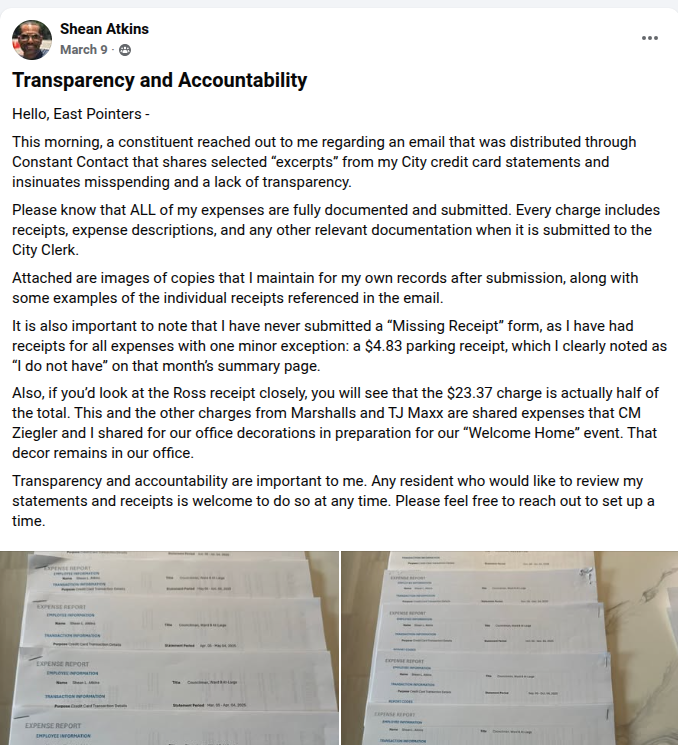
In a March 9 post to the East Point Neighbors Facebook group, CM Atkins addressed questions raised after a resident retrieved Open Records questioning several expenses attached to his city-issued credit card.
Atkins claimed that he had only ever filed one missing receipt form, for $4.83.
“It is also important to note that I have never submitted a “Missing Receipt” form”, Atkins wrote, ” as I have had receipts for all expenses with one minor exception: a $4.83 parking receipt, which I clearly noted as “I do not have” on that month’s summary page”.
Atkins included photos of the receipts he was inventorying.
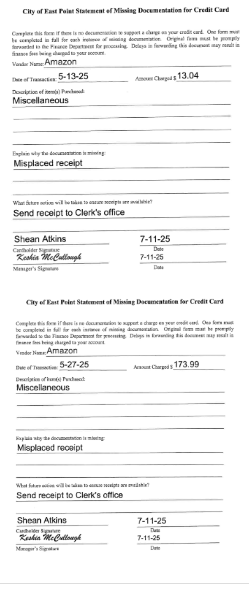
However, our research unearthed twenty nine missing credit card receipt forms attached to his city issued credit card, along with his name.
These forms range in cost to the city from $8.00 at NAP Colony Square, to $13.41 at Wal-Mart, to $20.64 at CVS Pharmacy, and almost a dozen charges at Amazon for items ranging in cost from $13.04 to $173.99.
To save space, only a select few receipts are viewable below.
In a Facebook post this morning, Councilmember Atkins denied impropriety and once again said he maintains records and receipts.
This is Part 1 of a 2 Part Investigative Report.
Check This Out...
-
The City Of East Point Announces Opening Of Pocket Park On Ben Hill Road On Friday, November 6
-
2 Weeks Until Election Day: Georgia Voters Have Turned In More Than One Million Ballots So Far
-
Happening Tonight: East Point City Council Meeting
-
City Of East Point To Host Dog Party Sunday, October 25: City Themes Event As “Howl-O-Ween Pawty”
-
75 Year Old East Point Grandmother Who Was Shot While Passing Out Food Tells WSB-TV She Can’t Walk, Was In Rehab For Months; Yearns To Pass Out Food Again: “I Miss It Every Time I’m Supposed To Go Out”