
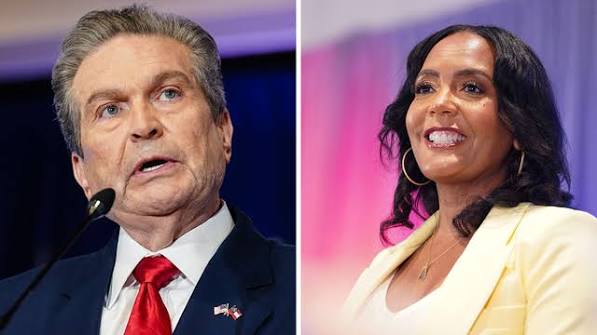
Georgia gubernatorial nominee Keisha Lance Bottoms ignited a bit of controversial chatter after stating that voters and entities aligned with her billionaire Republican opponent, Rick Jackson, can be “bought and sold.”
The remarks, reported by the Atlanta Journal-Constitution via X on July 27, 2026, highlight underlying factors of race and money in the razor-thin race for Georgia governor– a historic matchup between a Black female former Mayor of Atlanta and a wealthy White Republican man who identifies as a Trump acolyte. Bottoms made the comments while criticizing Jackson’s heavy campaign spending and alleged narrative manipulation.
The “Bought and Sold” Comments
Speaking on her opponent’s campaign tactics, Bottoms leveled a sharp critique against the influence of Jackson’s personal fortune.
“I’m not mad about his money. But I am mad about the way that he is manipulating the narrative with his money,” Bottoms stated. “And for everybody who is taking money from him, God bless you. A good friend of mine who’s probably in his room often reminds me: If you can be bought, you can be sold.”
Fallout from the “Toast on Lenox” Backlash
The “bought and sold” warning represents a direct extension of a controversial, weeks-long social media discussion involving a popular Atlanta restaurant. The controversy originally erupted after Rick Jackson posted a photo with Tamara Young, the co-owner of Toast on Lenox, a prominent Black- and woman-owned establishment in Buckhead.
The restaurant gained web-wide notoriety over Jackson’s visit and photo op, with many commenters criticizing Young and the eatery for hosting the Republican candidate, who has promised to attack DEI initiatives in the state if elected governor.
Some accused Jackson of using Minority-owned small businesses as “political props.”
Though the restaurant owners explicitly clarified that the photo was simply a routine courtesy extended to a visiting guest, the viral uproar led to online boycott threats.
Political analysts note that Bottoms’ latest comments effectively shift the focus from the business itself to a social focus–a focus that cannot be overlooked because of the demographic, racial, and economic sub-factors of the race.
Swift Republican Pushback
The Republican camp and conservative leaders across Georgia immediately weaponized the comments, framing them as an attack on everyday citizens and small business owners.
A spokesperson for the opposition countered heavily, stating, “Keisha Lance Bottoms went after a Black woman-owned restaurant because Rick Jackson ate a meal there, and now she is telling Georgians that anyone who stands with him has a price.” Critics claim that Bottoms is trying to “cancel” Georgia families, working-class voters, and Minority business owners who do not explicitly align with the Democratic platform.
The Defense from Bottoms’ Campaign and Supporters
Supporters and campaign officials swiftly pushed back against the expected Republican criticism, dismissing it as a manufactured nothing-burger, while also reframing the “bought and sold” warning as an essential defense against the corrupting power of unprecedented political spending. Rather than an attack on everyday voters, the campaign argued that her comments targeted the systemic manipulation of the election by an ultra-wealthy elite.
In an official statement addressing the fallout, the Bottoms campaign pivoted directly to Jackson’s astronomical $87 million television advertisement buy.
“Rick Jackson made a billion dollars off of taxpayer-funded contracts with the state for healthcare services, even while rural hospitals closed and Georgians lost healthcare coverage, and now he’s trying to buy this election,” the campaign statement declared via X. “Jackson’s in this for himself, and Keisha’s the only candidate in this race who will stand up for Georgians.”
On social media and the campaign trail, high-profile Democratic allies and local supporters amplified this message through several core arguments:
Exposing Manufactured Photo-Ops: Supporters emphasized that Bottoms’ original Instagram warnings were meant to protect Black- and women-owned small businesses from being used as “political props.” They argued that Jackson’s sudden interest in Minority-owned establishments like Toast on Lenox is a calculated strategy to mask a policy platform that actively harms those same communities.
Highlighting Healthcare Hypocrisy: Pro-Bottoms organizers heavily circulated data regarding Jackson’s medical staffing fortune, contrasting his personal wealth with his staunch opposition to expanding Medicaid in Georgia. Defenders argued it is entirely fair to question the financial motivations of organizations accepting funds from a billionaire who opposes critical healthcare access for lower-income Georgians.
A Call for Genuine Conviction: At the grassroots level, supporters defended the “bought and sold” idiom as standard political rhetoric meant to inspire voters to value policy over financial influence. They maintained that Bottoms was simply reminding the electorate to remain vigilant against political figures who attempt to sweep policy failures under the rug using multi-million dollar ad blitzes.
Stakes for the 2026 Gubernatorial Race
This rhetorical escalation comes as polling highlights a neck-and-neck battle for the governor’s mansion. Recent polling figures show a close race that is within the margin of error.
With early voting and the general election looming, both campaigns are fighting aggressively to excite their base while appealing to voters in the political center. Jackson continues to aggressively tie his platform to economic growth and traditional conservative messaging, while Bottoms maintains that Jackson is blindly following Donald Trump “off a moral and economic cliff.”
Trump’s approval rating sits at Shows 36% approve and 57% disapprove in Georgia, placing him 21 points underwater.
If Bottoms wins in November, she will make history as the state’s first Black and first female governor, and the first Black female governor in U.S. history.
Check This Out...
-
Former President Barack Obama Electrifies Packed Ohio Venue In Support Of The State’s Senate, Gubernatorial Candidates: Obama Says “Basic Decency” Now Missing From The Nation’s Politics, Reminds Voters He Kept Nukes From Iran Without War
-
More Than Half The Country Believes Trump Has Committed Impeachable Offenses, Including a Quarter Of Republicans: Poll
-
13 Days Until Election Day: With Polls Showing Tight Races, Could Georgia Democrats Pull Off A Slatewide Sweep?
-
Ohio Republican Vivak Ramaswamy Faces Growing Criticism Over $4 Million Campaign Ad Against Democratic Opponent Featuring Her Estranged Mother
-
2 Weeks Until Election Day: Georgia Voters Have Turned In More Than One Million Ballots So Far