
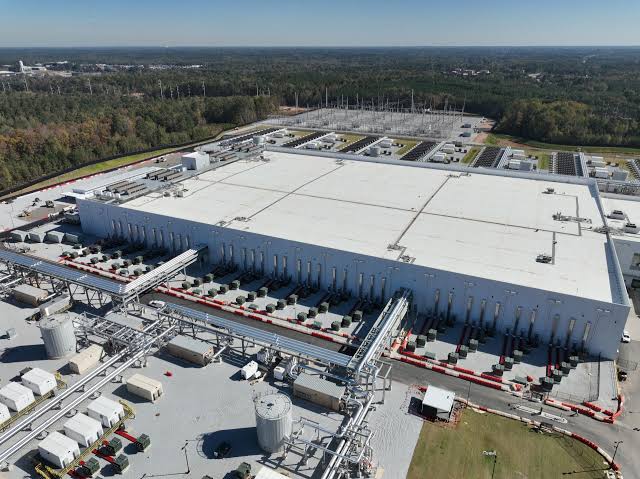
Georgia’s data center boom has reached a critical flashpoint as explosive growth collides with intense local resistance, grid capacity anxiety, and an escalating political battle ahead of the state’s gubernatorial race. Where does the state stand today as the issue of data centers impacts debate from local city halls to Congress?
Georgia is currently the second-largest data center market in the United States, trailing only Northern Virginia. Propelled by the demands of artificial intelligence and cloud computing, the state currently hosts 17 operational data centers and has at least 83 more facilities planned or under development.
The epicenter of this digital gold rush—historically clustered around Metro Atlanta—is rapidly shifting. Hyperscalers like Microsoft, Google, and Meta are purchasing expensive land along the I-20 corridor and pushing deep into rural and coastal communities.
The Xcale of the Expansion Is Unprecedented:
The OpenAI Mega-Project: OpenAI recently announced Project Camellia, a massive $20 billion AI data center in coastal Effingham County. Spanning thousands of acres northwest of Savannah, the facility will demand an astounding 3.2 gigawatts of electricity by 2032.
Google’s Rural Push: Google recently announced a new data center under construction in LaGrange, marking its second massive footprint in the state.
Off-Grid Pivots: In Social Circle, a data center facility made headlines for trying to bypass grid limitations by installing its own massive, off-grid fossil-fuel generators to secure primary power.
The Battle for the Power Grid and Private Property
The sheer volume of electricity required by these server farms is outstripping existing grid capacity, triggering major infrastructure overhauls. Georgia Power estimates that data centers will account for 70% to 80% of all new energy demand on its upcoming transmission lines.
This reality hit home this week as Georgia Power advanced its Ashley Park-Wansley Transmission Project, a 35-mile high-voltage corridor cutting across Fayette, Heard, Fulton, and Coweta counties. To build these lines, the utility company is leveraging eminent domain to seize and demolish nearly 30 residential homes, provoking fierce community anger from residents who feel their generational wealth is being sacrificed to power Big Tech.
Compounding the problem, recent Georgia Tech research revealed that local power prices jump by about 5% after a data center opens. Environmental advocates and figures like U.S. Senator Raphael Warnock are also raising alarms about water scarcity, noting that these water-cooled facilities place severe stress on rivers during a period of intense drought.
Local Moratoriums and the Industry’s PR Counter-Offensive
Fed-up municipal leaders are taking matters into their own hands, creating a fragmented regulatory map across the state. Roughly one in five Georgia counties has enacted or is drafting data center ordinances:
Augusta unanimously voted to extend its moratorium on data centers for another 60 days following heavy public pushback over water and energy costs.
Cherokee County approved an initial 30-day freeze on data center development with eyes on a 180-day extension. Fearing a complete legislative shutdown, the tech sector is pushing back. The Georgia Chamber of Commerce launched the Georgia Digital Infrastructure Alliance to highlight the small businesses, construction jobs, and tax revenue these facilities bring to rural areas. Meanwhile, another industry group, Connected Georgia, has blanketed local media with millions of views on ads attempting to reframe data centers as pillars of a smarter grid.
DeKalb County extended its freeze through September, while cities like Conyers explicitly stated they have no plans to ever permit or zone for data centers.
Fearing a complete legislative shutdown, the tech sector is pushing back. The Georgia Chamber of Commerce launched the Georgia Digital Infrastructure Alliance to highlight the small businesses, construction jobs, and tax revenue these facilities bring to rural areas. Meanwhile, another industry group, Connected Georgia, has blanketed local media with millions of views on ads attempting to reframe data centers as pillars of a smarter grid.
The Political Campaign Trail Hotbed
With state lawmakers having successfully watered down or blocked major data center regulatory bills earlier this year, the issue has officially leaked into high-stakes politics.
Governor Brian Kemp, who has strongly championed the tech boom, recently signed Donald Trump’s Ratepayer Protection Pledge, an agreement meant to ensure tech companies pay the upfront infrastructure costs. Kemp maintains that a blanket moratorium would be “irresponsible” for rural counties begging for economic development.
However, the future of the industry rests heavily on upcoming elections. Democratic gubernatorial nominee Keisha Lance Bottoms has called for an immediate statewide construction moratorium on data centers. Simultaneously, two critical seats on the Georgia Public Service Commission are on the ballot, which will decide the ultimate fate of how Georgia Power structures its energy mix—and who will pay the bill for the AI revolution.
Check This Out...
-
10 Days Until Election Day: Michigan Voters Could Vote To Restrict Utility Industry Cash In The State’s Elections With Approval Of Prop 2
-
Longtime 82 Year Old Virginia State Senator Indicted: L. Louise Lucas Faces Federal Charges Accusing Her Of Trafficking Marijuana And Money Laundering: Lucas Vows To Fight Charges: “I’m Not New To This. I’m True To This”
-
Six Charlotte Cops Face Termination Over Texts Allegedly Containing Text Message Thread Filled With Racial Slurs, Racial Profiling, And Police Brutality: Allegedly Competed To Pull Over The Most Black Drivers: Texts Came To Light Amid Flock Camera Misuse Investigation
-
Handcuffs With That Order? Popular San Diego Chef Allegedly Kidnapped And Shot Ex-Girlfriend In Iowa In 2014, Then Fled The State: Social Media Popularity Led U.S. Marshals To Him
-
Federal Judge Blocks Deportation Of 28 Year Old NYC Man Shot By ICE Agents Thursday: Who Is Oscar Belgal, And What Are The Circumstances Surrounding His Case?