
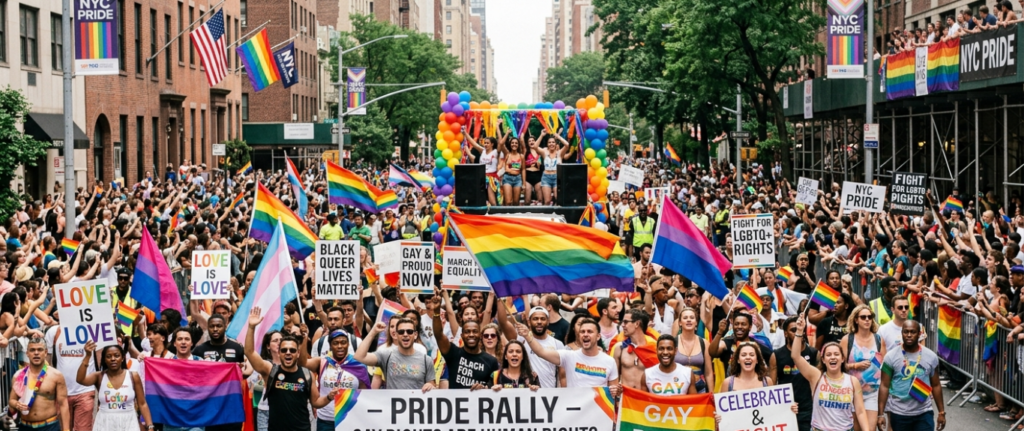
The LGBTQ+ community in the United States currently faces a complex landscape defined by record-breaking legislative activity, landmark court battles, and a significant mental health crisis among youth. While national acceptance for issues like marriage equality remains high, a polarized political environment has led to a “state of emergency” for many in the community.
This is the socio-political landscape facing the Gay Community in today’s America–more than a decade after the landmark case that upheld marriage equality nationwide, Obergefell v. Hodges, was ratified by the Supreme Court.
A Legislative “State of Emergency” Persists:
The last few years have seen an unprecedented surge in state-level legislation targeting LGBTQ+ individuals, particularly transgender people.
- Record Bill Counts: In 2025 alone, the ACLU tracked 616 anti-LGBTQ bills. By early 2026, over 760 bills were already under consideration across 43 states.
- Targeted Restrictions: Common legislative themes include bans on gender-affirming healthcare for minors (now law in 27 states), restrictions on school sports participation (29 states), and “bathroom bans” (25 states).
- “Sex Definition” Laws: A newer trend involves broad laws that redefine “sex” across state codes based on biological sex at birth, which can effectively invalidate transgender legal identities on documents like driver’s licenses and birth certificates.
High-Stakes Legal Battles:
Major legal precedents are currently being weighed by the judicial system, with outcomes that could reshape rights for decades.
- Supreme Court Rulings: In the 2024–2025 term, the Supreme Court heard United States v. Skrmetti, a case challenging Tennessee’s ban on gender-affirming care for minors. A decision is expected to determine if such bans violate the Equal Protection Clause.
- Identification and Passports: Legal challenges continue against policies that restrict the ability of transgender and nonbinary people to update sex designations on federal and state documents.
- Education and Free Speech: Recent cases like Mahmoud v. Taylor (2025) have addressed whether parents can opt their children out of lessons featuring LGBTQ-themed books, highlighting the tension between school inclusion and religious expression.
The Youth Mental Health Crisis:
The intense political focus on LGBTQ+ identities has correlated with worsening mental health outcomes for young people.
- Rising Distress: According to The Trevor Project, LGBTQ+ youth reporting suicidal ideation grew from 41% to 47% in recent years.
- Impact of Discrimination: LGBTQ+ youth are over four times more likely to attempt suicide than their peers, often citing discrimination and legal hostility as major stressors.
- Safety Concerns: Roughly 28% of transgender and nonbinary youth reported being physically threatened or harmed in the past year due to their gender identity.
Public Support vs. Political Polarization:
Despite legislative pushes, broader American public opinion remains largely supportive of LGBTQ+ protections.
- Nondiscrimination Support: Approximately 75% of Americans support policies that protect LGBTQ+ people from discrimination in housing and employment.
- Marriage Acceptance: Roughly 67% of Americans support same-sex marriage, with high support across most religious groups.
- Political Representation: Despite the hostile climate, LGBTQ+ representation in elected office grew by 2.4% between 2024 and 2025, with a record number of out representatives in the U.S. House.
While the “state of emergency” declared by advocacy groups reflects real-world safety and legal concerns, the ongoing resilience of the community is evidenced by continuing legal victories and growing representation in local and national government.
Check This Out...
-
Atlanta Pride Updates Sunday Schedule, Cancels Saturday Events Due To Weather Circumstances: The Popular Parade And Multiple Other Events Will Take Place Tomorrow
-
Fulton County District Attorney Fani Willis To Host LGBT+ Question And Answer Session On Tuesday, September 29: Event Will Be Held Ahead Of Atlanta Pride, National Coming Out Day
-
The Unusual Circumstances Surrounding 31 Year Old Deundray Cottrell’s Death Sparked Viral Speculation: His Ex-Boyfriend Has Now Been Charged With His Killing
-
Former Transportation Secretary Pete Buttigieg Says America Is Ready For A Gay President On NBC’s “Meet The Press”: He Also Addresses Prior Lack Of Support From Black Voters
-
Black Pride Gets Fully Underway In The Metro: The Event Features Poetry Slam, Music, And More Celebrating The Black LGBT+ Community: More Than 100,000 People Expected To Attend Various Events