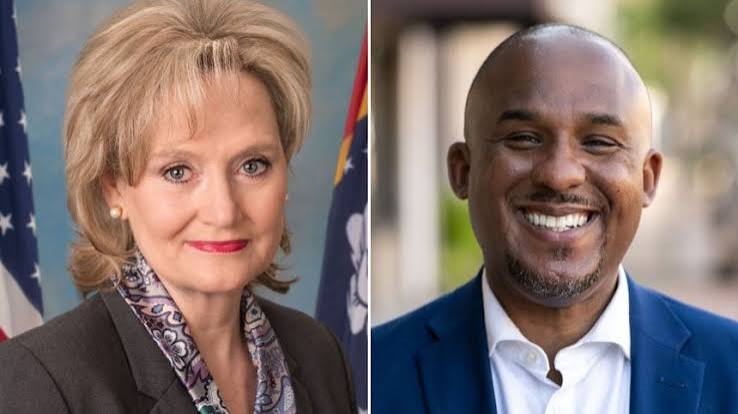
The 2026 Mississippi Senate race between incumbent Republican Sen. Cindy Hyde-Smith and Democratic challenger Scott Colom is showing signs of becoming unexpectedly competitive, despite election handicappers historically labeling the seat as “Solid Republican.” Recent polling data, a surge in Democratic primary turnout, and aggressive national investments indicate that the race could be significantly closer than observers originally anticipated.
Recent fundraising totals for Colom reveal, for the second reporting period in a row, he has outraised incumbent Senator Hyde-Smith, an ardent Trump backer who is struggling with low approval numbers.
Democrats once ruled the state but that was during the segregation era–a time when the party was dominated by White Southern racist “Dixiecrats” and Republicans were seen by many Black voters as more sympathetic to their concerns. But over the many years since then, those roles have reversed and Democrats haven’t been able to elect one of their own to the U.S. Senate in decades as Republicans in the state have consistently supported policies that generally do not align with Black voting concerns.
But Scott Colom’s strong campaign, an evolving and diversifying state electorate, and a Democratic party that appears to be surging in the once-confederate stronghold are giving Democrats hope that an upset might be in the making while also providing hope the party is slowly turning The Magnolia State blue.
Polling and Turnout Signal a Tightening Race
Every major election handicapper—including the Cook Political Report—has long considered Mississippi safe territory for Republicans: Mississippi has not sent a Democrat to the U.S. Senate since 1982.
However, internal data and recent public shifts suggest that incumbent Sen. Cindy Hyde-Smith is entering the final stretch of the midterms as a vulnerable incumbent. A poll released by the Southern Policy Law Center Action Fund and Impact Research showed Hyde-Smith carrying a net negative 55% unfavorable rating, placing her just three points ahead of Democratic challenger Scott Colom in a head-to-head matchup.
This statistical tightening is mirrored by raw voter enthusiasm. In the March primary elections, Democratic voter turnout surged by over 80% compared to previous cycles, bringing the total Democratic primary vote within just 8,000 ballots of the Republican total. This builds on recent structural momentum in the state, following a historic push where state Democrats successfully broke the Republican supermajority in the Mississippi State Senate.
The Fundraising Battle: Colom vs. Hyde-Smith
Financially, the race presents a classic battle between incumbent institutional backing and high-momentum challenger fundraising.
- The Challenger: Scott Colom, a district attorney from Lowndes County, proved his financial viability early by outraising Hyde-Smith in the final quarter of 2025, pulling in $420,327 compared to the incumbent’s $357,995. However, following the primary season, Colom’s campaign saw a dip in cash flow. According to recent filings with the Federal Election Commission (FEC), Colom reports just under $560,000 in cash on hand.
- The Incumbent: Backed by national political action committees and a high-profile fundraising event held at Mar-a-Lago with Donald Trump, Hyde-Smith has built a substantial war chest. The incumbent has raised more than $2.7 million during this election cycle alone. Her campaign holds a significant advantage with over $2.4 million in cash on hand—outpacing Colom’s cash reserves more than four times over.
- Second Quarter of 2026 (Q2 2026): But according to July 2026 Federal Election Commission (FEC) filings, Colom outraised Hyde-Smith for a second time, pulling in roughly $765,500 to her $431,000.
Outside Spending Helps Keep Fundraising Competitive
Recognizing the tightening margins, national organizations are moving to bridge the financial divide between the two candidates. The Democratic super PAC American Bridge 21st Century announced a $2 million investment specifically targeting Mississippi.
National strategists point out that Mississippi’s media markets are dramatically less expensive than battlegrounds like Texas or Pennsylvania, meaning outside multi-million dollar ad buys go much further in defining the narrative.
The race remains a steep uphill climb for the challenger, especially with Independent candidate Ty Pinkins on the November ballot potentially siphoning away anti-incumbent votes. Nevertheless, with Hyde-Smith’s dragging favorability numbers and a heavily funded opposition, the Magnolia State is shaping up to host one of the most surprising battlegrounds of the midterm cycle, indicating a changing Mississippi that may be on the cusp of delivering electoral surprises for Democrats.
A Struggling Electorate Looking For Change
While changing demographics drive the long-term political trajectory, the immediate debate on the campaign trail focuses heavily on Mississippi’s systemic challenges. The state historically trails the rest of the country across a broad spectrum of economic, health, and social indicators, providing a potent rhetorical platform for a Democratic challenger demanding change.
According to data compiled by USAFacts, Mississippi consistently faces significant hurdles relative to national averages:
Economic Disparity: Mississippi ranks at the bottom of the nation in median household income and has one of the highest poverty rates in the United States, hovering near 19%.
Healthcare Infrastructure: The state ranks last in overall healthcare access and outcomes, exacerbated by the ongoing rural hospital crisis and the state’s refusal to expand Medicaid under the Affordable Care Act.
Education and Opportunity: Despite recent gains in elementary reading scores, Mississippi still lags in higher education attainment and experiences high rates of “brain drain,” where college graduates leave the state to seek higher-paying jobs elsewhere.
Shifting Demographics and “The New Georgia” Trajectory
Underpinning this unexpected competitiveness is a gradual but definitive shift in Mississippi’s demographic makeup. U.S. Census Bureau data underscores that while the state’s overall population has experienced slight declines in rural areas, its urban centers and suburban pockets—such as DeSoto County—are becoming significantly more diverse.
Mississippi boasts the highest percentage of Black residents by comparison to any state in the nation: Thirty eight percent of the state’s residents identify as Black. And following the two major parties switching sides over civil rights, Black voters in Mississippi have shown overwhelming support for the Democratic platform, which indicates a strong electoral base for the future of Democrats in the state.
Right now, national strategists are increasingly drawing parallels to recent political transformations in the American South. During a media appearance, U.S. Sen. Lisa Blunt Rochester, vice chair of the Democratic Senatorial Campaign Committee (DSCC), declared that “Mississippi is the new Georgia,” pointing to the state’s changing political trajectory and its pool of non-White eligible voters.
Breaking Barriers and Unlocking Turnout
For decades, Mississippi’s voter laws and structural boundaries have been a factor in how effectively these changing demographics translated into Democratic electoral outcomes. However, the organizational landscape is shifting:
- Legal and Redistricting Battles: Recent court interventions and ongoing voting map discussions have been part of efforts to align legislative boundaries with the racial demographics of the state.
- Mobilizing the Unheard Voter: According to the University of Florida Election Lab, Mississippi traditionally ranks lower in the country in overall voter participation. Advocacy groups are focusing on voter registration and mobilization campaigns targeting young, diverse, and minority residents who have historically had lower participation in elections.
While the Republican party holds a majority of statewide offices, the combination of an increasingly diverse electorate and heightened Minority voter engagement contributes to a dynamic political environment that could deliver a surprise electoral outcome in 2026 and beyond.
Check This Out...
-
Former President Barack Obama Electrifies Packed Ohio Venue In Support Of The State’s Senate, Gubernatorial Candidates: Obama Says “Basic Decency” Now Missing From The Nation’s Politics, Reminds Voters He Kept Nukes From Iran Without War
-
More Than Half The Country Believes Trump Has Committed Impeachable Offenses, Including a Quarter Of Republicans: Poll
-
13 Days Until Election Day: With Polls Showing Tight Races, Could Georgia Democrats Pull Off A Slatewide Sweep?
-
Ohio Republican Vivak Ramaswamy Faces Growing Criticism Over $4 Million Campaign Ad Against Democratic Opponent Featuring Her Estranged Mother
-
2 Weeks Until Election Day: Georgia Voters Have Turned In More Than One Million Ballots So Far