
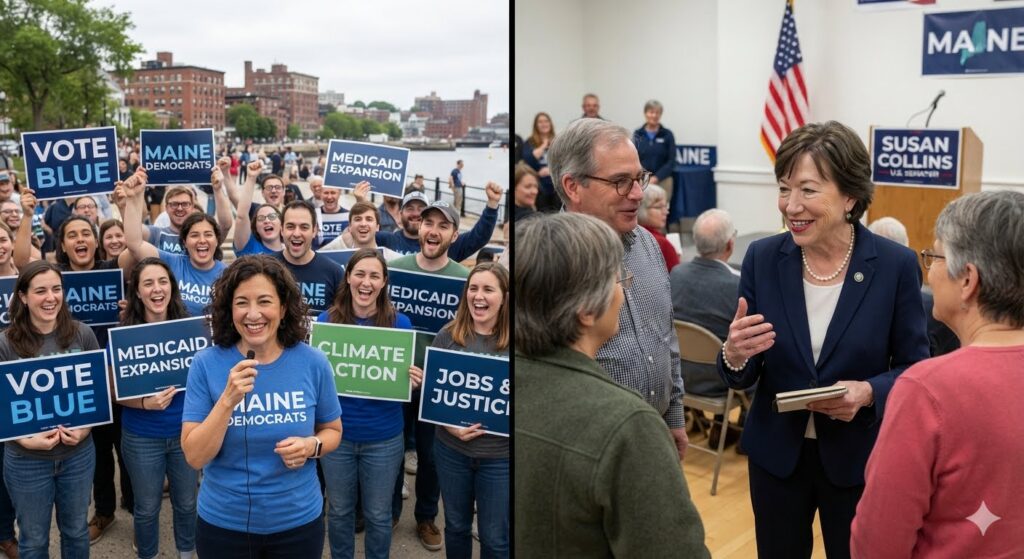
Following the abrupt exit of progressive veteran Graham Platner, who suspended his campaign amid an explosive sexual assault allegation that he denies, the state party has been thrown into an unusual intraparty battle. With less than four months until Election Day and a strict statutory deadline of July 27 to finalize a replacement on the ballot, a crowded field of contenders is aggressively vying to take on five-term Republican incumbent Senator Susan Collins–an often dependable Trump vote in the Senate who Democrats nationwide would like to see defeated.
A Scramble for Delegates Under Tight Deadlines
Because Platner formally withdrew just ahead of state-mandated deadlines, Maine election law bypasses a traditional public primary do-over. Instead, the state party voted to hold an emergency nominating convention scheduled for July 25 in Bangor.
The format has turned typical campaign strategy on its head. Rather than buying television ads or courting general election voters, twelve Democratic hopefuls are racing to secure 500 signatures by July 20 just to qualify for the ballot. From there, the race is a pure insider sprint to win over the 601 state delegates who will determine the nominee.
Factions Clash Over the Party’s Direction
The rush to fill the vacuum has exposed deep, lingering divisions between the establishment and progressive wings of the party. Platner had run on an anti-establishment, populist platform that resonated with voters frustrated by Washington. Behind the scenes, figures from Platner’s political operation are working to ensure his successor comes from the party’s progressive flank.
However, the field is heavily populated by candidates looking for a political second act:
Troy Jackson: The former progressive State Senate President is widely seen as the ideological heir to Platner’s base. Allies quickly mobilized a digital campaign to draft him into the race immediately following Platner’s exit.
Shenna Bellows: The current Secretary of State launched an active campaign to unify the state party, positioning herself as a fighter for the working class.
David Costello: The former environmental official is mounting his second Senate push of the year after finishing third in the June primary.
Dan Kleban: The co-owner of Maine Brewing Company is pitching himself as an outsider, banking on the fact that he never endorsed Platner during the primary cycle.
High Stakes and Halting Debates
The tension of this compressed timeline was fully on display during a recent two-hour candidate debate featuring eight of the contenders. Observers noted the performance was plagued by stilted deliveries and halting answers as candidates struggled to project a cohesive vision on short notice.
The primary challenge for whoever emerges from the convention is the lack of time. While national groups like the Senate Majority PAC have committed at least $24 million to help Democrats flip the seat, the eventual nominee will have to quickly introduce themselves to the broader Maine electorate. This stands in stark contrast to Collins, who commands an immense fundraising apparatus and decades of name recognition.
National analysts at the University of Virginia Center for Politics still rate the Maine Senate race as a Toss-up. Despite the chaos, party strategists note that Democrats may ultimately end up with a significantly less damaged nominee than Platner, whose campaign had been plagued by multiple personal controversies even before the final, race-ending allegation.
With the Bangor convention just days away, the frantic push to court local delegates will decide whether Maine Democrats can unite quickly enough to choose among a field of 12 candidates in order to unseat one of the most resilient Republicans in the country.
Winning Maine Is A Mathematical Necessity In Order To Have A Chance To Re-Take The Senate
For Democrats aiming to reclaim the U.S. Senate majority this November, unseating five-term Republican incumbent Susan Collins in Maine is considered an absolute mathematical necessity. To overcome the Republican majority, Democrats must secure a net pickup of four seats. Crucially, Maine stands alone as the only highly competitive 2026 battleground where a Republican senator is running for reelection in a state that voted for the Democratic presidential nominee in 2024.
If the state party fails to flip this pivotal Pine Tree State seat—a path made more complicated following the sudden withdrawal of Platner—strategic analysts warn that Democrats will have virtually no viable alternative route to control the upper chamber. Consequently, defeating Collins is not just an ambitious target for national Democrats, but the vital keystone required to alter the balance of power in Washington.
Check This Out...
-
Former President Barack Obama Electrifies Packed Ohio Venue In Support Of The State’s Senate, Gubernatorial Candidates: Obama Says “Basic Decency” Now Missing From The Nation’s Politics, Reminds Voters He Kept Nukes From Iran Without War
-
More Than Half The Country Believes Trump Has Committed Impeachable Offenses, Including a Quarter Of Republicans: Poll
-
13 Days Until Election Day: With Polls Showing Tight Races, Could Georgia Democrats Pull Off A Slatewide Sweep?
-
Ohio Republican Vivak Ramaswamy Faces Growing Criticism Over $4 Million Campaign Ad Against Democratic Opponent Featuring Her Estranged Mother
-
2 Weeks Until Election Day: Georgia Voters Have Turned In More Than One Million Ballots So Far