
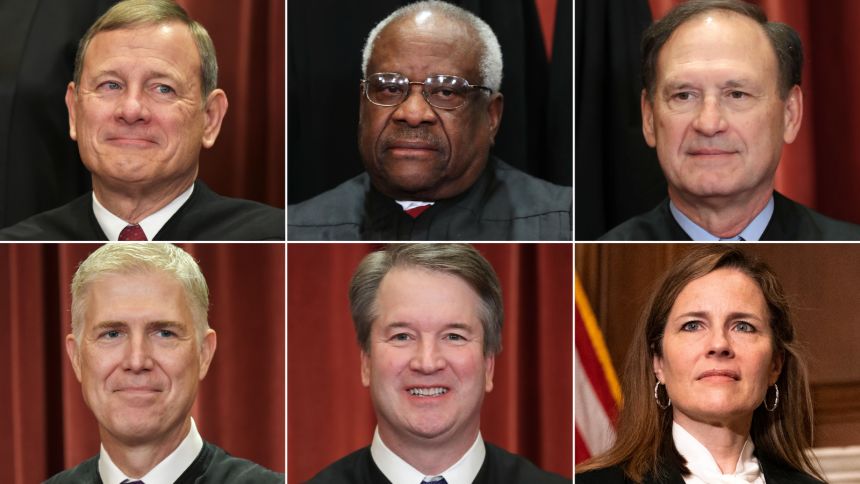
America’s right wing conservative majority on the Supreme Court has struck down abortion rights in Dobbs v. Jackson Women’s Health Organization (2022); expanded Second Amendment rights by striking down a New York law that required individuals to demonstrate “proper cause” to carry a handgun in public in New York State Rifle & Pistol Association, Inc. v. Bruen (2022); effectively ended the use of affirmative action in college admissions, ruling that race-based admissions programs violate the Equal Protection Clause in Students for Fair Admissions v. Harvard (2023); and in Agency Power Rulings (2024-2026), the Court systematically curbed the regulatory authority of executive agencies (such as ending the Chevron doctrine), fundamentally limiting how the federal government can enforce environmental, labor, and public health laws.
In the 6-3 conservative-led decision in Trump v. United States, the high court ruled that former presidents have absolute immunity from criminal prosecution for actions within their core constitutional powers and are presumptively immune for all other official acts, a move that many constitutional experts and Democrats believe has paved the way for President Trump to avoid future legal scrutiny for policies and business moves that may come under investigation if Democrats re-rake the House majority in November or if he is succeeded by a Democrat in the White House in 2028.
And then there is the concern from many on the left that the Court may go even further right, potentially weighing in with conservative rulings on gay and interracial marriage, for instance.
Just this year, the Court struck down decades of voting precedent by removing voting protections for Black Americans in Louisiana v. Callais (2026): In a 6-3 decision, the Court substantially rewrote and weakened Section 2 of the VRA. The ruling struck down Louisiana’s congressional map, making it incredibly difficult for voters of color to challenge racially discriminatory voting maps while allowing Republicans nationwide to redraw voting maps that overwhelmingly favor the GOP–and severely restrict Black political representation.
In the minds of many Court historians, today’s right wing Court is the most conservative in 90 years, and many point to the Court’s intervention earlier in the century in Bush V. Gore as a rightward turning point when the Court essentially stopped the counting of ballots in Florida in order to award George W. Bush the presidency.
Here’s a timeline of the Court’s rightward shift, which has been 40 years in the making:
1980s: The Rise of the Federalist Society: Founded in 1982 by law students at Yale, Harvard, and Chicago, this conservative network promoted “originalism”—interpreting the Constitution strictly based on its meaning at the time of enactment. This movement gained immense traction during the Reagan administration, serving as the ideological pipeline for future nominees.
1986: The Rehnquist Court: President Ronald Reagan elevated staunch conservative William Rehnquist to Chief Justice. This era initiated a steady rightward shift, marked by a judicial aversion to business regulations and rulings that favored states’ rights over expansive federal power.
1991: The Appointment of Clarence Thomas: Succeeding Thurgood Marshall, Thomas brought a consistent, originalist conservatism to the bench. This marked the beginning of a durable right-leaning bloc.
2000: Bush v. Gore: The Court’s intervention in the 2000 election highlighted its increasingly political nature and preserved a crucial window for conservative appointments.
2005–2006: The Roberts Court: Under Chief Justice John Roberts, joined by George W. Bush’s appointees (Roberts himself and Samuel Alito), the Court began aggressively expanding religious liberties, striking down key components of the Voting Rights Act, and rolling back campaign finance regulations.]
2016: Senate Blockade: Following the death of Justice Antonin Scalia, the Republican-controlled Senate blocked the nomination of Merrick Garland for nearly a year. This unprecedented move preserved the open seat for Donald Trump, altering the trajectory of the Court.
2017–2020: The Trump Appointments: President Donald Trump, working with Senate Majority Leader Mitch McConnell, appointed Neil Gorsuch, Brett Kavanaugh, and Amy Coney Barrett. These three appointments firmly locked in a robust 6-3 conservative supermajority.
2022: Overturning Roe v. Wade: Powered by the new supermajority, the Court ruled in Dobbs v. Jackson Women’s Health Organization, eliminating the constitutional right to an abortion and fulfilling a decades-long goal of the conservative legal movement.
Check This Out...
-
Six Charlotte Cops Face Termination Over Texts Allegedly Containing Text Message Thread Filled With Racial Slurs, Racial Profiling, And Police Brutality: Allegedly Competed To Pull Over The Most Black Drivers: Texts Came To Light Amid Flock Camera Misuse Investigation
-
Handcuffs With That Order? Popular San Diego Chef Allegedly Kidnapped And Shot Ex-Girlfriend In Iowa In 2014, Then Fled The State: Social Media Popularity Led U.S. Marshals To Him
-
Federal Judge Blocks Deportation Of 28 Year Old NYC Man Shot By ICE Agents Thursday: Who Is Oscar Belgal, And What Are The Circumstances Surrounding His Case?
-
Mike Ditka Dies At 86: Legendary Chicago Bears Player And Later Head Coach Led The ’85 “Bad News Bears” To Super Bowl Win
-
Colorado Parents Who Take Their Small Kids On Record-Breaking Mountain-Climbing Ventures Reported To Child Protective Services By Online Critics, Won’t Be Prosecuted