
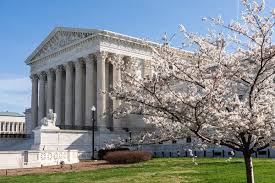
In a widely expected decision that could distort the Fall’s midterm elections, the United States Supreme Court gutted a key provision of the 1965 Civil Rights Act that specifically protected African-American voters from racist voting laws.
The Court’s ruling fell on predictably ideological lines: The Court’s six conservatives voted to strike down the provision while the Court’s three liberal Justices voted to maintain it.
By virtue of its order, the Court has now opened the door for Republicans nationwide to redraw district lines months before voters cast ballots in elections up and down the ballot. The result: States do not have to consider race when gerrymandering their districts. This means states, even those with a lengthy history of suppressing Black voting rights, are now free to draw districts in such a way that voters may soon see a significant fraction of Black congressional, legislative, and even county and municipal officeholders drawn out of their majority-Black districts.
Even overwhelmingly minority-majority districts such as Georgia’s 5th congressional district, based in Atlanta and once held by the late civil rights hero John Lewis, but now held by Congresswoman Nikema Williams, could also face a redraw.
In fact, prior to today’s Court ruling, legal observers opined that a third of the majority-Black districts in the U.S.could be redrawn, resulting in a number of Black congressional representatives facing redrawn districts that they may not prevail in or forcing incumbents of the same party to run against one another.
The Court’s liberal Justices correctly noted that Minority voters will be affected, Black voters specifically will suffer the primary electoral consequences of the decision.
“Under the court’s new view of section 2, a state can, without legal consequence, systematically dilute minority citizens’ voting power,” Kagan wrote in a dissent that was joined by Justices Sonia Sotomayor and Ketanji Brown Jackson. “The majority claims only to be ‘updat[ing]’ our section 2 law, as though through a few technical tweaks. In fact, those ‘updates’ eviscerate the law.
“Today’s decision renders section 2 all but a dead letter,” she continued. “The decision here is about Louisiana’s district 6. But so too it is about Louisiana’s district 2. And so too it is about the many other districts, particularly in the south, that in the last half-century have given minority citizens, and particularly African Americans, a meaningful political voice. After today, those districts exist only on sufferance, and probably not for long.”–The Guardian
At the center of the case, Louisiana v Callais, was the question of how much lawmakers are allowed to consider race when they redraw districts to ensure that Black voters are adequately represented.
Several states are expected to now rush to redraw their lines to take advantage of the Court’s decision before the midterms.
Republicans have been forecast to lose the House and possibly the Senate due to their attachment to President Trump’s unpopular social and economic policies in addition to his war against Iran. The Supreme Court’s decision is viewed by many as a significant assist for the GOP and Trump to hold onto or even expand their power.
Republican Florida governor Ron Desantis unveiled a massive re-write of Florida’s congressional lines on Monday, even though Florida’s Constitution prohibits gerrymandering based on political considerations. Desantis referenced the Court’s pending decision in urging his state’s legislators to quickly approve the state’s new map.
Check This Out...
-
More Than 520,000 Ballots Have Been Cast In Georgia Since Early In-Person Voting Began On Tuesday
-
20 Days Away: Democratic U.S. Senator Jon Ossoff, Republican Mike Collins Debate: Epstein Files, Tariffs, And Allegations Of Antisemitism Figure Prominently In Second And Final Debate Between The Two Candidates
-
Early In-Person Voting Begins Today October 13
-
Democratic Michigan Senate Candidate Dr. El-Sayed Addresses Past Obama Criticism, Jewish Safety In Meet The Press Interview
-
In November, Democrats Could Take A Majority Of Governorships For The First Time Since 2010